
A few years back, a student scrolling Instagram late at night sees an ad for a laptop bag. Doesn’t buy it. Two days later, googling “best laptop bags under 1500,” the same brand shows up on page one. A week after that, an email lands in the inbox with 20% off, because that same student had clicked “add to cart” and left without paying. None of that happened by accident. Every single touchpoint was planned, tracked, and paid for by someone who understood online marketing well enough to catch that student at exactly the right moment, three separate times, without ever meeting them.
That’s the whole game. Online marketing isn’t posting on Instagram because it feels productive. It’s the practice of reaching people through the internet, at the right time, with the right message, and then measuring whether it actually worked. This guide breaks that down properly, without assuming any background in business or marketing. If the word “SEO” or “CPC” makes eyes glaze over, good, because by the end of this, they won’t.
Here’s what gets covered: what online marketing actually means, why it matters more for students today than it did five years ago, the channels that make up the field, how all of it connects into one system, the terms people throw around in interviews, and a real roadmap for getting started, including what jobs look like and what they pay. Nothing here needs a business degree to follow.
Marketing was never really about products. It’s about attention. Online marketing just changed where that attention lives, and how precisely someone can measure it.
What Is Online Marketing?
Online marketing is the practice of promoting a product, service, brand, or idea using the internet as the medium. That’s the formal version. In plain terms, it means using websites, search engines, social media, email, and apps to get in front of people who might buy something, and then convincing them to act.
Break the definition down piece by piece, because each word is doing work.
Promoting means it’s intentional. A friend posting a photo with a coffee mug isn’t marketing. A coffee brand paying that friend to post it, with a specific caption and a discount code, is.
Using the internet as the medium is the part that separates it from a hoarding on the highway or a newspaper ad. Everything happens through a screen, which means everything can be tracked, clicked, measured, and adjusted mid-campaign, something a billboard could never do.
Getting in front of people who might buy something is targeting. Online marketing rarely tries to reach everyone. It tries to reach the right seven hundred people out of seven million, because that’s cheaper and it works better.
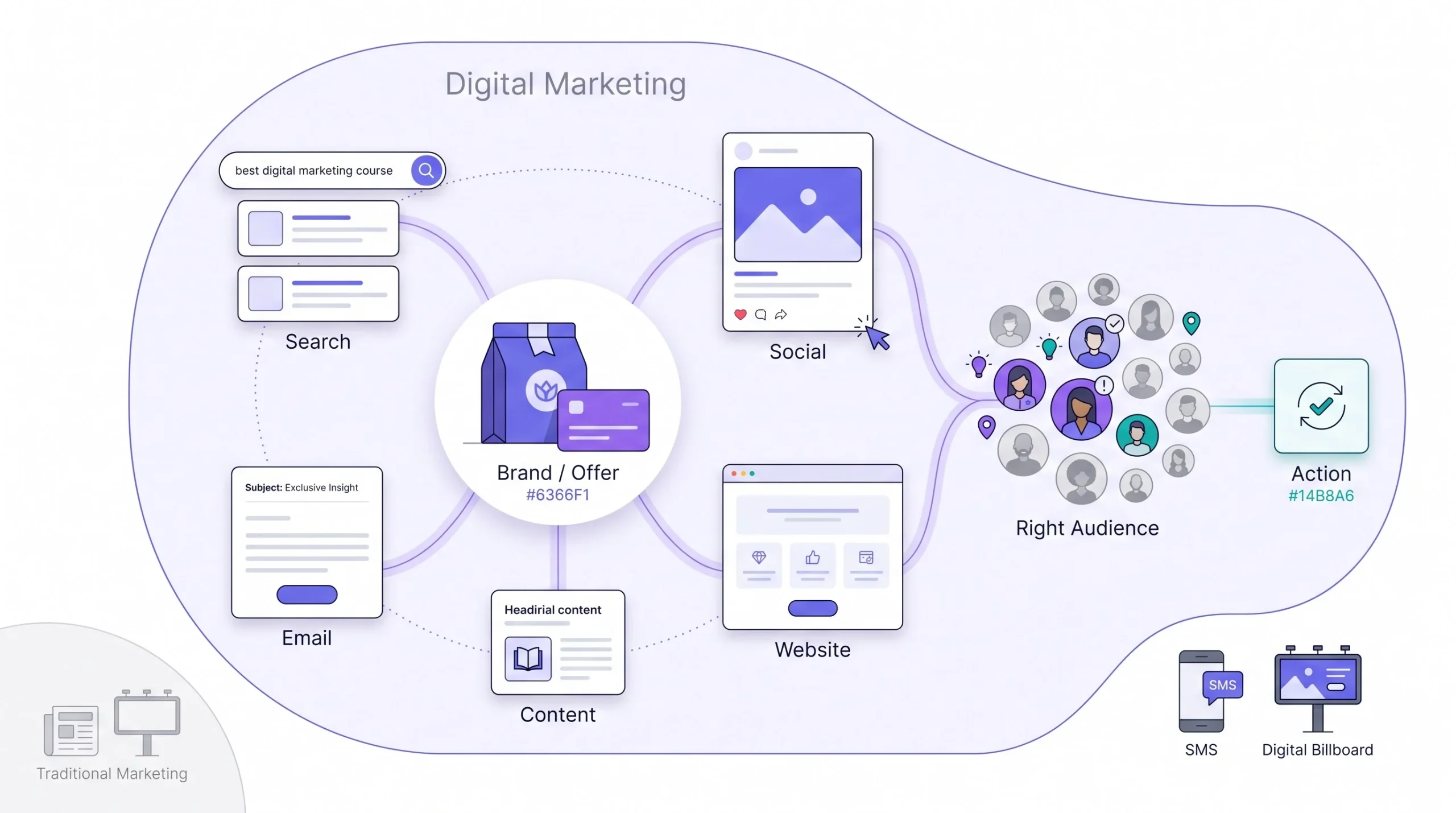
Now, three terms get used almost interchangeably in job listings and casual conversation: online marketing, internet marketing, and digital marketing. Technically, there’s a difference, and it’s worth knowing even if nobody enforces it strictly in practice. Digital marketing is the broader umbrella. It includes anything using digital technology, whether or not it needs an internet connection, so SMS marketing, digital billboards, and even TV ads booked through a digital ad exchange all count as digital marketing. Online marketing and internet marketing are subsets that specifically require the internet. So SEO, Google Ads, Instagram, email, all of that sits inside digital marketing, but it’s specifically the “online” slice of it. In real job descriptions, nobody splits hairs over this. But knowing the distinction stops confusion later when reading job titles or course syllabi that use the terms loosely.
| Term | What It Covers | Needs Internet? | Example |
|---|---|---|---|
| Traditional Marketing | TV, radio, print, hoardings, cold calling | No | A newspaper ad for a car dealership |
| Digital Marketing | All digital tech, online and offline | Not always | An SMS coupon code, a digital billboard |
| Online Marketing | Internet-based promotion specifically | Yes | A Google Ads campaign, an Instagram post |
Why Online Marketing Matters, Especially for Students
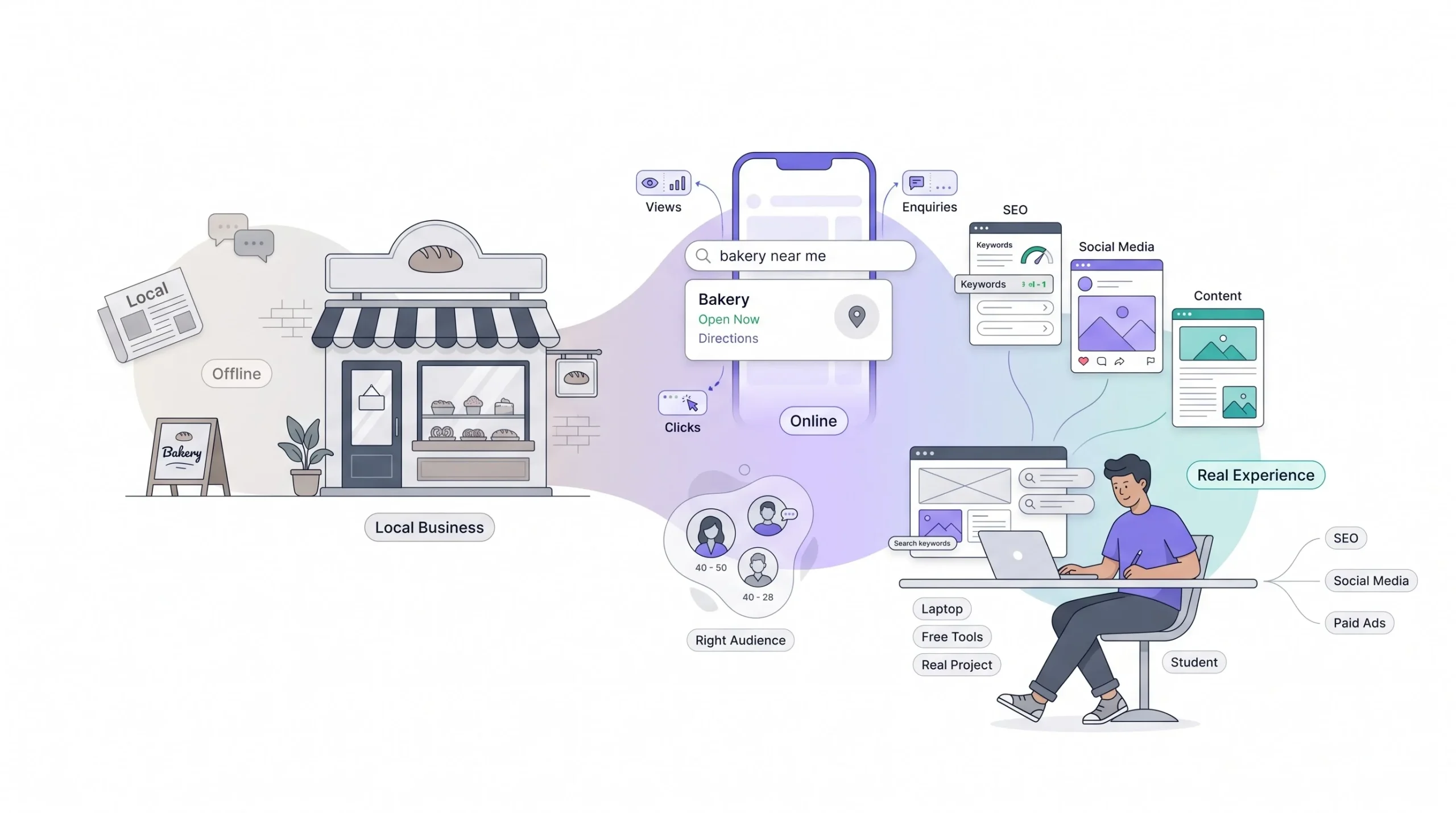
Look at what actually changed. Ten years ago, a business could survive on word of mouth and a signboard. Today, a customer looking for a tuition center, a bakery, or a laptop repair shop in a Tier-2 city almost always starts with a Google search or an Instagram reel, on a phone, not a laptop. Internet access in smaller Indian cities and towns has grown fast, cheap data plans made sure of that, and businesses that ignored this shift simply lost customers to the ones that didn’t. A shop in Indore with no Google Business listing today is, for practical purposes, invisible to half the people searching for exactly what it sells.
For a business, online marketing solves problems traditional marketing couldn’t touch. It’s cheaper to start, sometimes free. It’s measurable down to the rupee, so a business owner knows exactly how many people saw an ad, clicked it, and bought something, instead of guessing whether that newspaper insert did anything. It’s precise. A gym in Jaipur can show ads only to people within 5 kilometers who are between 20 and 35 years old and follow fitness pages. A newspaper ad can’t do that. It reaches everyone who bought the paper that day, fitness enthusiast or not.
India’s digital advertising market is expected to grow past $14 billion in 2026, growing at more than 10% a year, and digital now accounts for close to 68% of all advertising spend in the country. That’s not a small shift. That’s the majority of ad money in India now flowing through the internet instead of TV and print. Which means the jobs are following the money.
Now here’s the part that matters for a student reading this. Online marketing has one of the lowest barriers to entry of any career field right now. Nobody’s asking for a specific degree. A student with a laptop, free time, and genuine curiosity can start learning SEO or running a small Instagram page for a local business this week, not after four years of college. Compare that to fields like law or medicine, where the entry cost is years of formal study before earning a single rupee. Marketing rewards people who actually do the work, build a portfolio, and can show results, degree or no degree.
Nobody needs permission to start. A free blog, a college fest Instagram page, or a friend’s small shop willing to let someone run their social media, that’s a real starting point. Not a hypothetical one.
A Brief Evolution: How Online Marketing Got Here
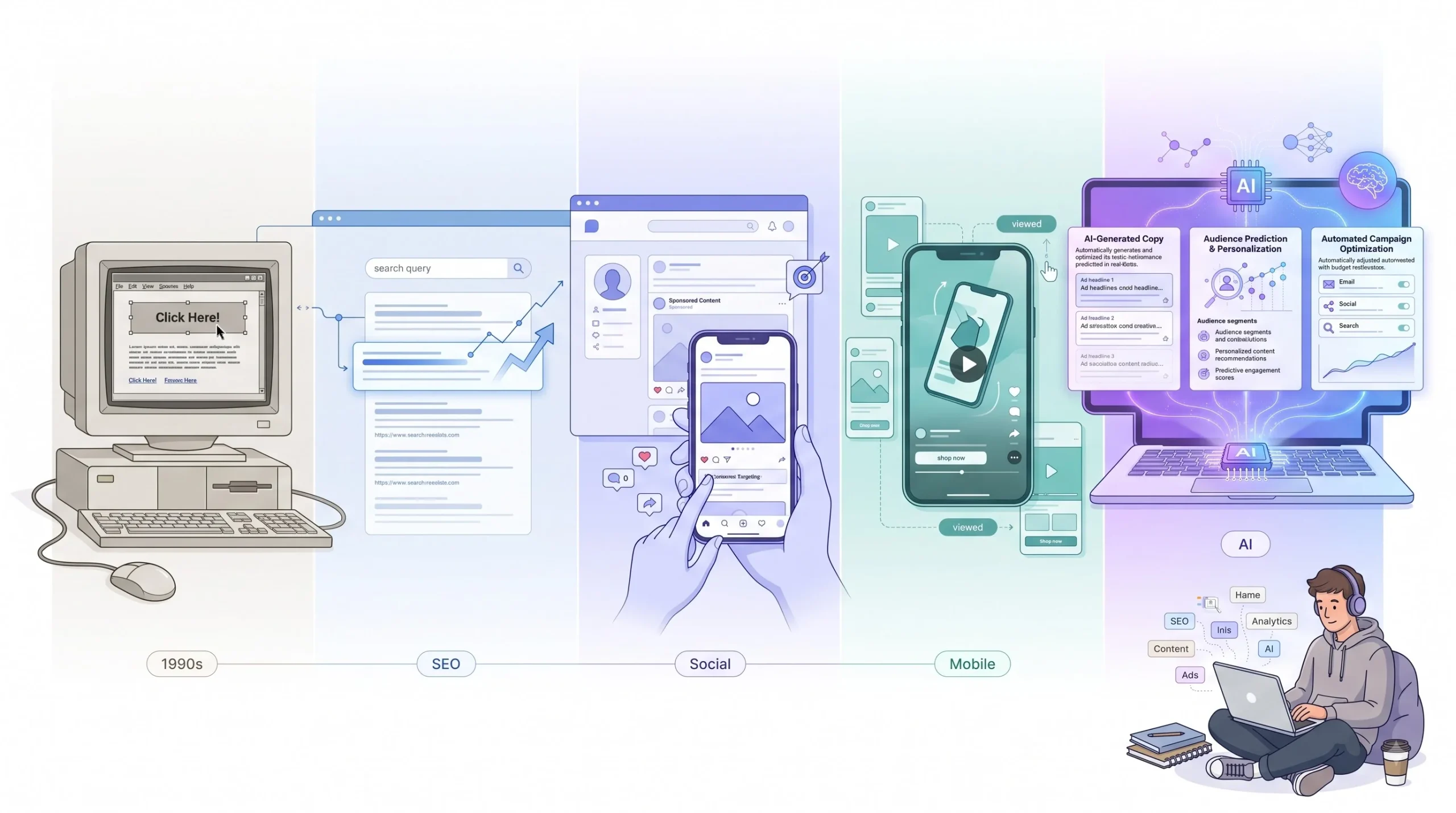
Worth understanding why the field looks the way it does today, because it didn’t arrive fully formed.
Online marketing effectively started in the 1990s with banner ads, ugly, flashing rectangles on early websites that nobody trusted and almost nobody clicked. Then search engines showed up properly in the early 2000s, and Google in particular figured out that ranking websites by relevance, not just by who paid the most, made search actually useful. That’s when SEO was born as a discipline, businesses realized that showing up on page one of Google mattered more than any banner ad ever did.
Social media changed things again between 2008 and 2015. Facebook opened up advertising to businesses, and suddenly a small shop owner could target ads the same way a big brand could, just with a smaller budget. That period is really when “digital marketing” as a job title started appearing on résumés.
From 2016 onward, mobile took over completely. More people in India started accessing the internet through a phone than a laptop, and video content, first YouTube, then Instagram Reels, then short-form everything, became the format that actually got attention. And now, from around 2020 onward, artificial intelligence has folded itself into nearly every part of the field, writing ad copy, predicting which audience will convert, personalizing what each user sees. The tools keep changing. What doesn’t change is the underlying goal: reach the right person, at the right time, with something relevant enough that they act.
This matters for a student specifically because the field ten years from now will not look like the field today. Whatever’s learned needs to sit on top of fundamentals that don’t expire, not just whatever tool happens to be trending this year.
Online Marketing vs. Traditional Marketing
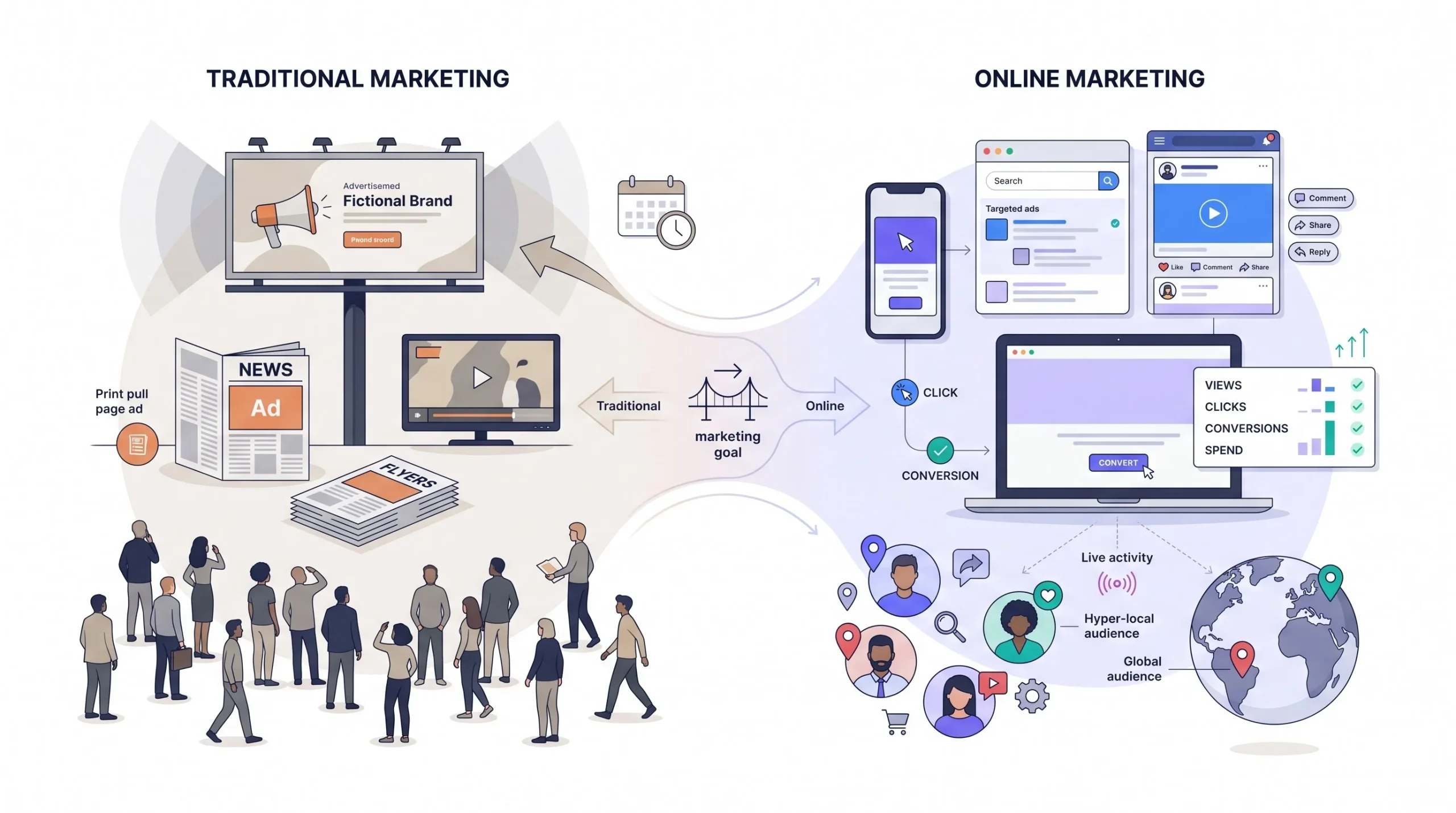
These aren’t enemies, plenty of big brands still run TV ads alongside Instagram campaigns, but the differences explain why online marketing grew so fast, especially among smaller businesses and individual creators who never could have afforded traditional advertising.
| Factor | Traditional Marketing | Online Marketing |
|---|---|---|
| Cost | High (TV, print, hoardings are expensive) | Can start with zero or very small budgets |
| Targeting | Broad, based on general demographics | Precise, based on interests, behavior, location |
| Measurability | Hard to track exact results | Every click, view, and rupee spent is trackable |
| Speed of Feedback | Weeks or months to see impact | Real-time, results visible within hours |
| Reach | Limited to a region or broadcast area | Global or hyper-local, fully adjustable |
| Interactivity | One-way (audience just watches or reads) | Two-way (comments, clicks, replies, shares) |
The measurability point deserves extra attention because it’s the single biggest reason businesses shifted budgets online. A business running a newspaper ad has no real way of knowing if that ad brought in three customers or three hundred. A business running a Google Ads campaign knows the exact number of clicks, the exact cost per click, and often the exact number of people who converted into paying customers. That kind of accountability didn’t exist before, and once business owners got a taste of it, going back to guesswork stopped making sense.
Paid vs. Organic Online Marketing
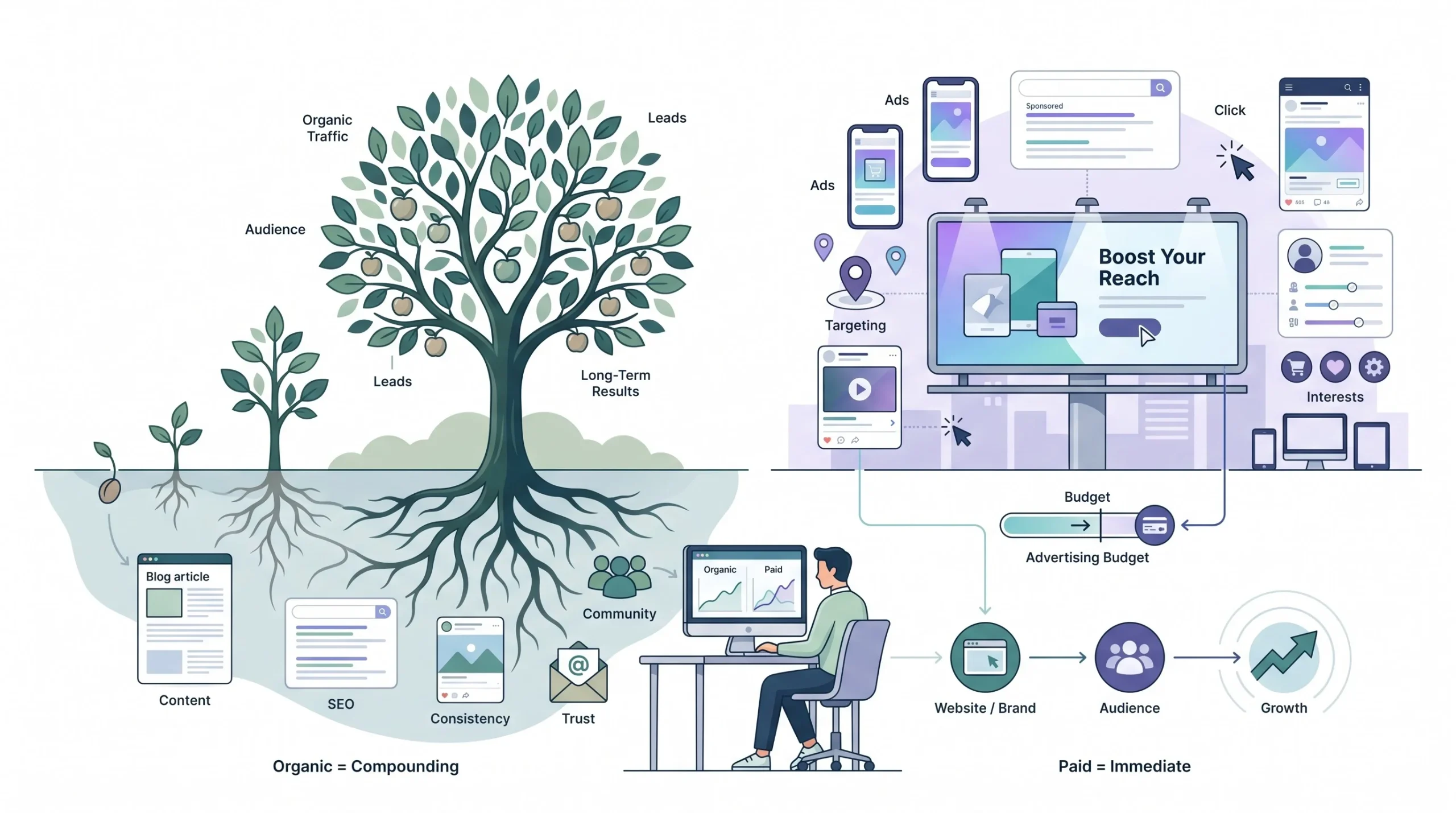
Before going channel by channel, this distinction needs to be locked in first, because every channel discussed later falls into one of these two buckets, sometimes both.
Organic marketing is visibility that isn’t paid for directly. Ranking on Google through SEO, growing an Instagram following through consistent posting, building an email list through free content, all of that is organic. It takes longer to show results, usually months rather than days, but it compounds. A blog post ranking on Google keeps bringing in visitors for years without ongoing ad spend.
Paid marketing is visibility bought directly. Running a Google Ads campaign, boosting an Instagram post, paying an influencer for a shoutout, that’s paid. It’s fast. A campaign can go live this afternoon and start bringing in clicks within the hour. But the moment the budget stops, so does the traffic.
Think of it like this. Organic is planting a tree. It takes time to grow, needs patience, but once it’s established it keeps producing fruit on its own. Paid is renting a billboard. Instant visibility, but the second the rent stops getting paid, the billboard comes down and nobody sees it anymore.
Most real jobs in this field don’t ask someone to pick a side. A social media executive runs organic content and manages a small ad budget. A growth marketer at a startup is often doing both simultaneously, because organic builds long-term trust and paid fills the gaps while that trust is being built.
The Core Channels of Online Marketing
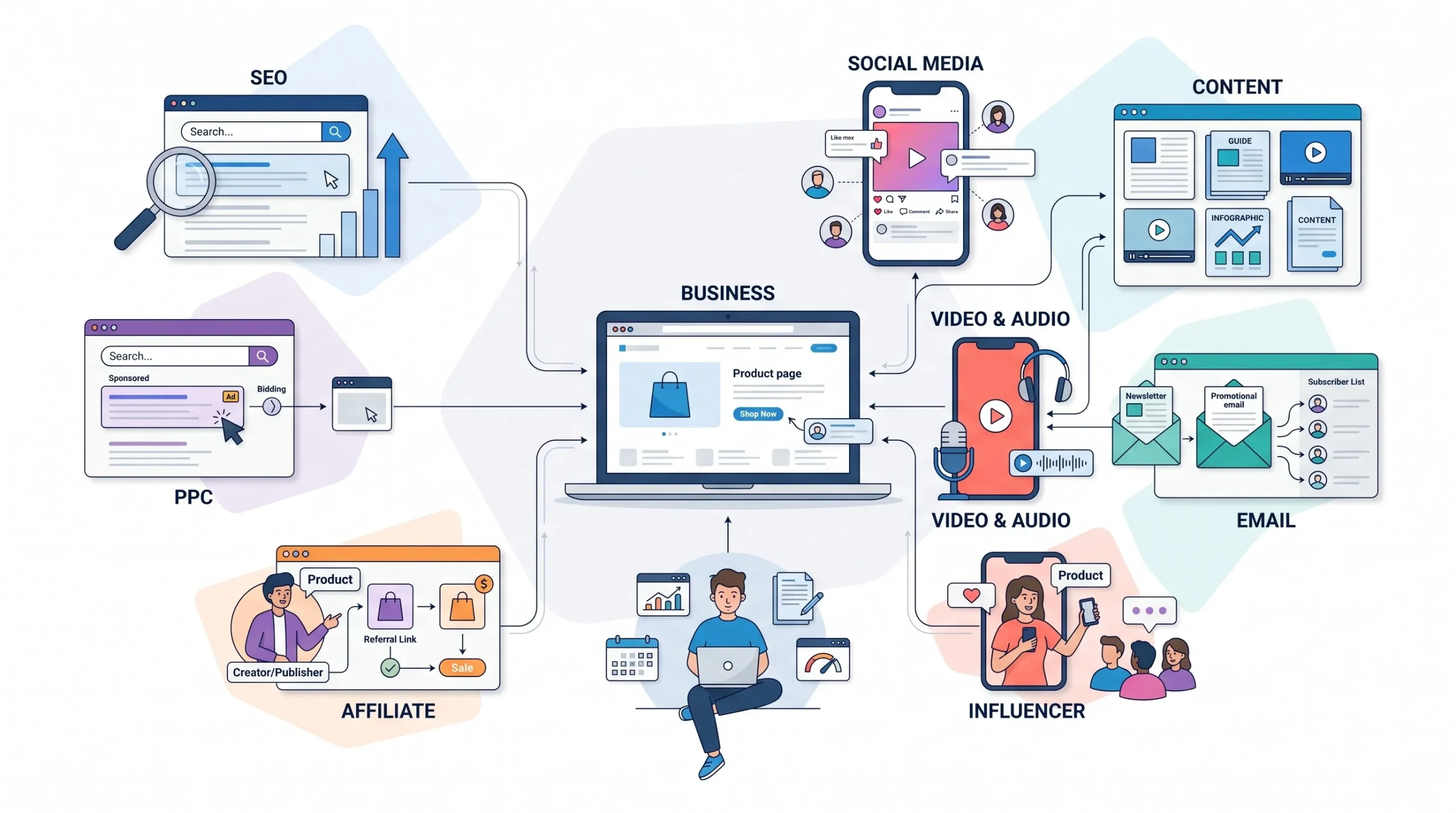
Each of these is its own specialization, and each deserves a full deep-dive of its own eventually. Here, the goal is just enough to actually understand what each one is and how it fits.
Search Engine Optimization (SEO)
SEO is the process of getting a website to rank higher in search results without paying for that placement. It works because Google’s algorithm crawls websites, reads their content, and decides which pages best answer a specific search query, then ranks them accordingly. A well-optimized page about “best digital marketing courses in Pune” has a real shot at showing up when someone searches exactly that.
What makes SEO worth learning first, honestly, is that it’s free traffic once it’s working. No daily ad spend required. The tradeoff is patience. SEO rarely shows results in week one. It usually takes a few months of consistent effort before rankings move meaningfully.
Pay-Per-Click Advertising (PPC / Google Ads)
PPC flips the SEO model. Instead of earning a spot on Google through content and time, an advertiser pays for it directly, and only pays when someone actually clicks the ad, hence “pay-per-click.” Google Ads runs an auction behind the scenes every time someone searches something, and the highest relevant bidder, combined with how good their ad actually is, wins the top spot.
This is where budgets and numbers come into the conversation early. A small business might spend ₹500 a day and get a handful of clicks. A larger e-commerce brand might spend lakhs per month across dozens of campaigns. The appeal is speed. Turn on a campaign today, get clicks today, unlike SEO’s multi-month runway.
Social Media Marketing
This covers both organic posting (building a following, engaging in comments, posting Reels) and paid social ads (running sponsored posts on Instagram, Facebook, or LinkedIn). Different platforms serve different purposes almost entirely. Instagram and YouTube lean visual and work well for brand building and product discovery. LinkedIn works for B2B and professional services. Facebook still holds strong for slightly older audiences and local business promotion, especially in smaller cities.
Content Marketing
Content marketing is the practice of creating genuinely useful material, blog posts, videos, guides, infographics, not to sell directly, but to build trust and authority first. It’s the engine underneath SEO (content is what actually ranks) and underneath social media (content is what actually gets posted). Almost every other channel depends on content existing in the first place.
Email Marketing
Easy to dismiss as old-fashioned, and yet it remains one of the highest-return channels in the entire field. The reason is simple: an email list is an audience a business actually owns. Instagram followers can vanish if the algorithm changes or the account gets flagged. An email list stays, and it lets a business talk directly to people who already showed interest, without paying a platform for the privilege.
Affiliate Marketing
Affiliate marketing pays people, called affiliates, a commission for driving sales through their own referral link. A YouTuber reviewing headphones and linking to them on Amazon, earning a small percentage of every sale through that link, that’s affiliate marketing in action. In India, platforms like Amazon Associates, EarnKaro, and Cuelinks make this easy to start with no coding involved, sign up, grab a link, drop it in a blog post or a bio. It’s performance-based, meaning the affiliate earns nothing unless a sale actually happens, which makes it attractive for businesses that don’t want to pay for traffic that doesn’t convert, and attractive for a student who wants to test whether their content can actually move people to buy something.
Influencer Marketing
Different from affiliate marketing because it’s usually paid upfront rather than performance-based. A brand pays a creator to feature a product, regardless of how many sales result. In India specifically, this has shifted heavily toward micro-influencers, creators with smaller but highly engaged followings, often 10,000 to 100,000 followers, who might charge anywhere from a few thousand rupees to ₹20,000-odd for a single Reel, compared to a celebrity endorsement running into lakhs. That price gap is exactly why brands are chasing micro-influencers now, more of them, cheaper each, and often better trusted by their audience than a film star holding a product for three seconds. Especially effective for reaching audiences in Tier-2 and Tier-3 cities, where a mega-celebrity endorsement feels distant but a local creator feels like a real person.
Video and Audio Marketing
YouTube, podcasts, and short-form video (Reels, Shorts) fall under this bucket. Video works because it holds attention longer than static images or text, and short-form specifically has become the dominant content format across almost every platform in the last few years. Podcasts serve a different purpose, building deep trust with a smaller, highly engaged audience who listens for 30 to 60 minutes at a stretch, something almost no other format achieves.
| Channel | Paid or Organic | Best For | Typical Cost Level | Time to See Results |
|---|---|---|---|---|
| SEO | Organic | Long-term website traffic | Low (mostly time investment) | 3–6 months |
| PPC / Google Ads | Paid | Fast, targeted traffic | Medium to High | Hours to days |
| Social Media | Both | Brand awareness, engagement | Low to Medium | Weeks to months |
| Content Marketing | Organic | Trust and authority building | Low (time-heavy) | Months |
| Email Marketing | Organic | Retaining and converting leads | Low | Weeks |
| Affiliate Marketing | Paid (performance-based) | Driving direct sales | Commission-based | Ongoing |
| Influencer Marketing | Paid | Reach and social proof | Medium to High | Days to weeks |
| Video/Audio | Both | Deep engagement, storytelling | Medium | Weeks to months |
How Online Marketing Actually Works: The Funnel
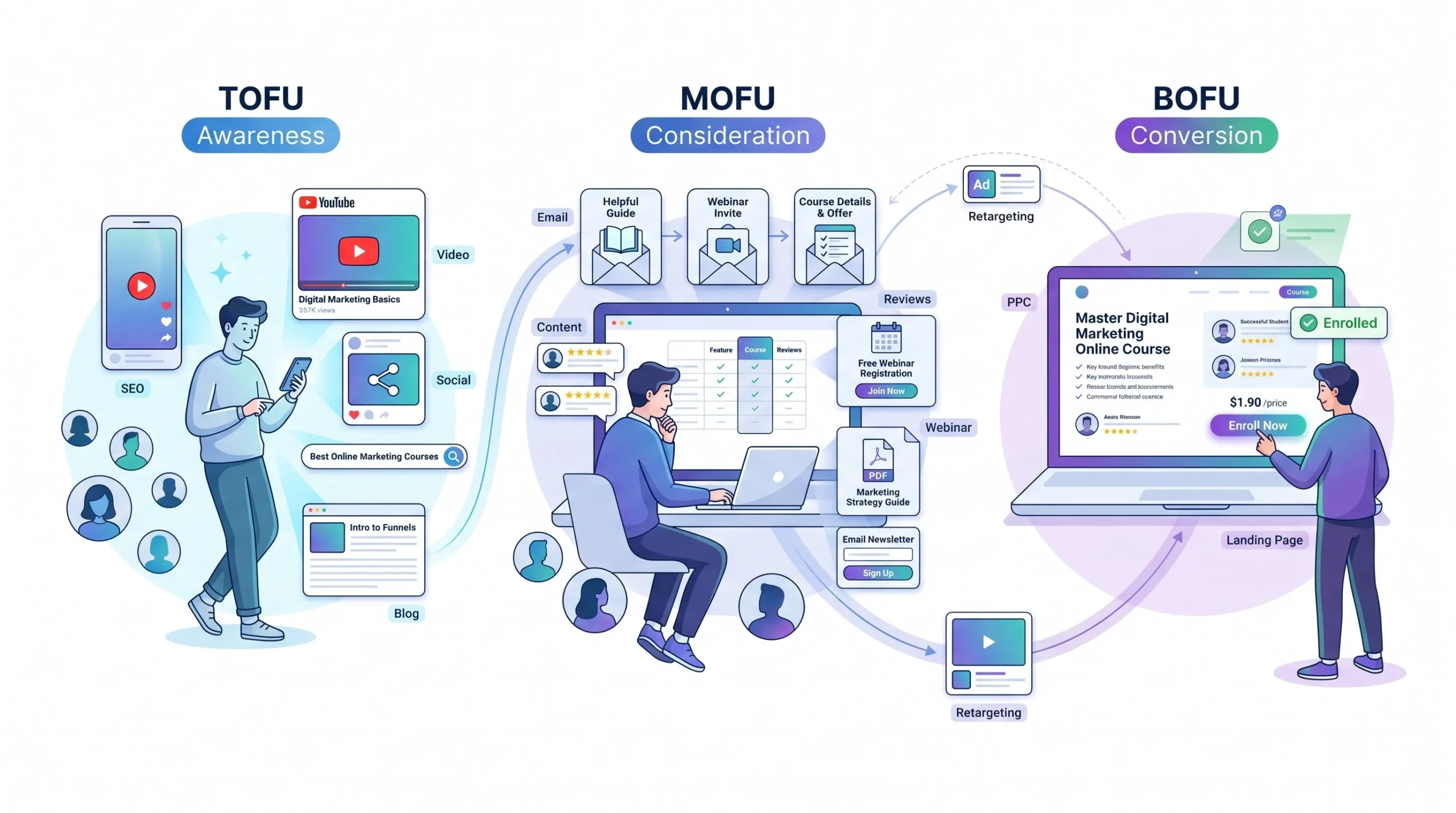
All these channels aren’t random, they map onto a system called the marketing funnel, which describes how a stranger turns into a customer through stages.
Picture a student who’s never heard of a particular online course platform. That’s the top of the funnel, or TOFU, the awareness stage. They come across it through a YouTube video or an Instagram post talking about digital marketing skills, something SEO or social media content usually handles.
Now that student is curious but not ready to pay. They start comparing options, reading reviews, maybe signing up for a free webinar or downloading a free guide. That’s the middle of the funnel, MOFU, the consideration stage. Email marketing does a lot of heavy lifting here, nurturing that lead with useful information until they’re closer to a decision.
Finally, that student decides to enroll. They land on a course page, see pricing, maybe get retargeted with a Google or Instagram ad reminding them the course exists after they left the page without paying. That’s the bottom of the funnel, BOFU, the conversion stage, where PPC and landing pages do most of the work, because the goal here isn’t awareness anymore, it’s closing the deal.
The mistake beginners make constantly is treating every channel as if its job is to sell immediately. SEO content rarely sells directly, its job is to get someone into the top of the funnel. A landing page’s job is entirely different, its job is to convert someone who’s already decided they’re interested. Mixing these up, like running a hard sales pitch on a blog post meant for awareness, is one of the most common reasons campaigns underperform.
Key Terms Every Beginner Should Know
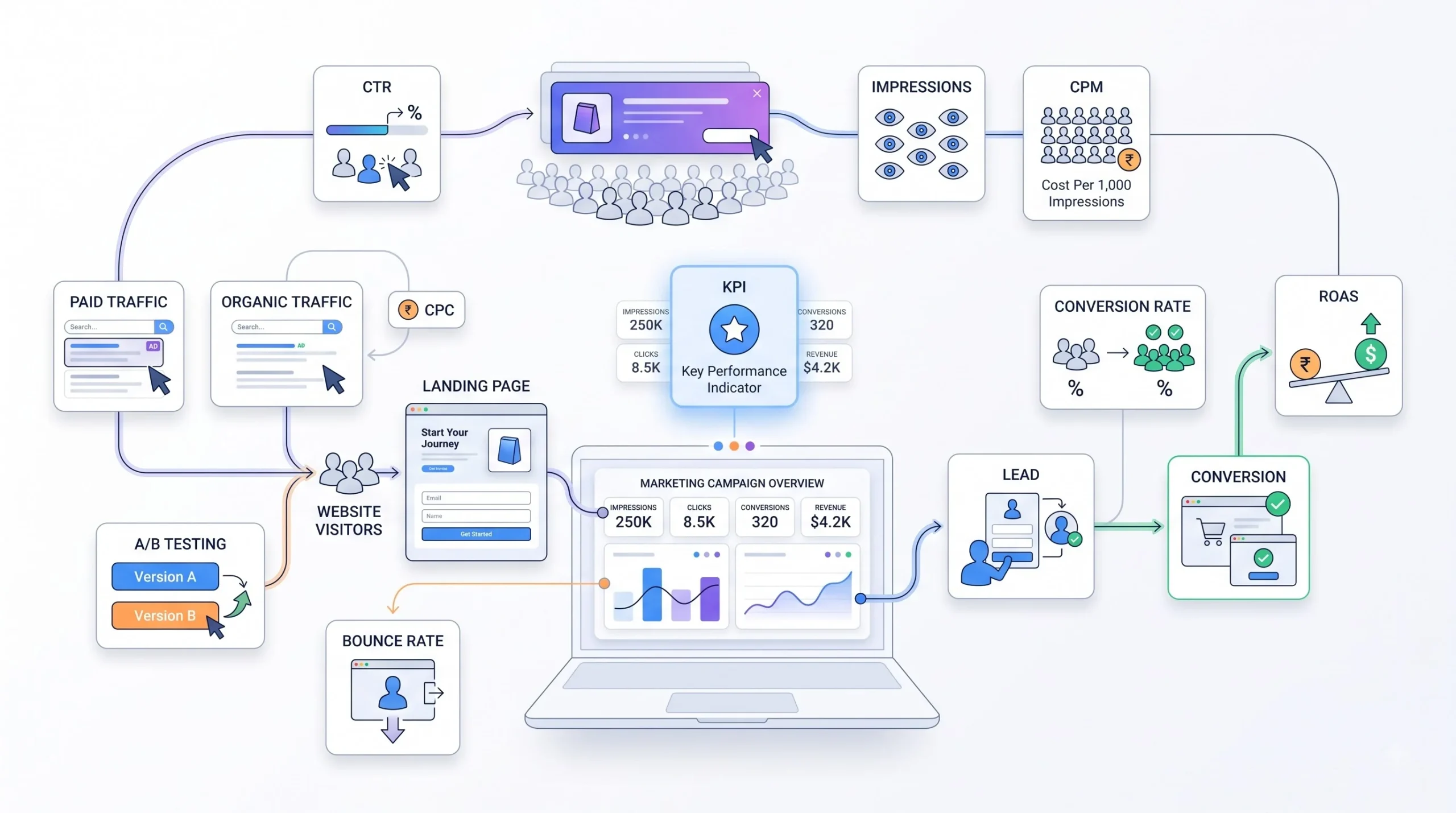
Every field has its own shorthand, and online marketing throws these terms around constantly in job interviews, meetings, and reports. Better to learn them properly now than nod along later pretending to understand.
| Term | Plain-English Meaning | Example |
|---|---|---|
| CTR (Click-Through Rate) | Percentage of people who saw something and clicked it | 100 people saw an ad, 5 clicked, that’s a 5% CTR |
| CPC (Cost Per Click) | How much is paid every time someone clicks an ad | An ad costing ₹10 per click |
| CPM (Cost Per Mille) | Cost per 1,000 impressions (views) of an ad | Paying ₹200 for every 1,000 times an ad is shown |
| Impressions | Number of times something was shown, whether clicked or not | An ad shown 10,000 times has 10,000 impressions |
| Conversion | The specific action a business wants (a sale, sign-up, download) | Someone buying a product after clicking an ad |
| Conversion Rate | Percentage of visitors who actually convert | 1,000 visitors, 20 buy something, that’s a 2% conversion rate |
| ROAS (Return on Ad Spend) | Revenue earned for every rupee spent on ads | Spending ₹1,000 and earning ₹4,000 back is a 4x ROAS |
| Bounce Rate | Percentage of visitors who leave a website after viewing just one page | A high bounce rate often means the page didn’t match what people expected |
| Lead | A person who’s shown interest but hasn’t bought yet | Someone who filled out a “get free consultation” form |
| Funnel | The path someone takes from stranger to customer | Awareness, consideration, conversion |
| Organic Traffic | Visitors who arrive without a business paying for that visit | Someone finding a website through a Google search |
| Paid Traffic | Visitors who arrive because a business paid for that placement | Someone clicking a Google Ads listing |
| Landing Page | A dedicated page designed to convert visitors into leads or customers | A page built specifically for a single ad campaign |
| A/B Testing | Comparing two versions of something to see which performs better | Testing two different email subject lines on separate groups |
| KPI (Key Performance Indicator) | The specific metric used to judge whether something worked | Using conversion rate as the KPI for a landing page |
Essential Tools Used in Online Marketing
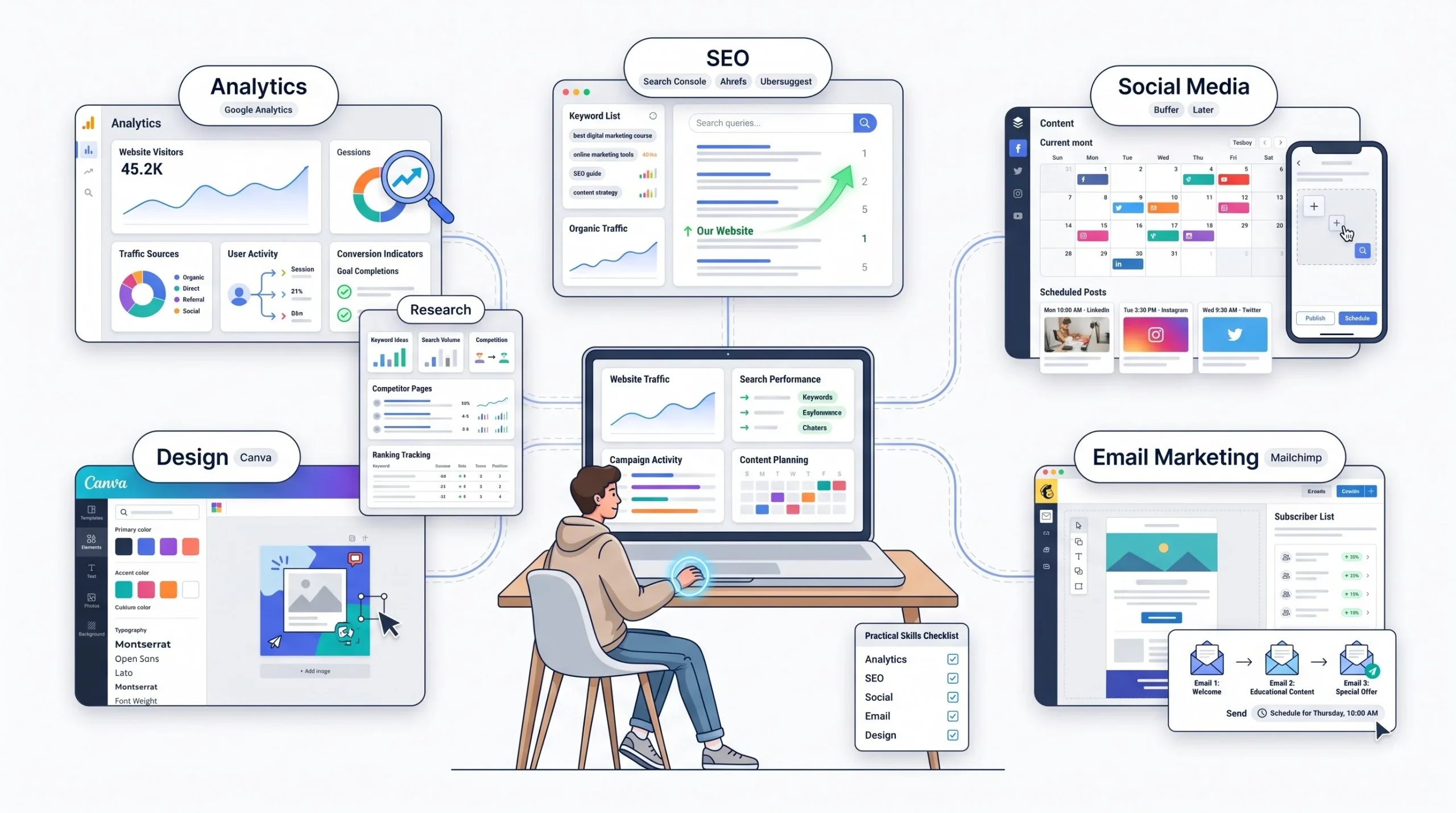
Knowing the theory doesn’t help much without knowing what actually gets opened on a laptop day to day. Here’s what’s genuinely used across most entry-level roles.
For analytics, Google Analytics is close to universal, it tracks who’s visiting a website, where they came from, and what they did once they arrived. For SEO specifically, Google Search Console shows exactly how a website performs in search results, and tools like Ubersuggest or Ahrefs help with keyword research and tracking rankings. For social media scheduling, tools like Buffer or Later let someone plan and queue posts across multiple platforms instead of manually posting every single day. For email marketing, Mailchimp remains a common starting point for sending newsletters and automated email sequences. For design, Canva has become close to essential, letting anyone create social media graphics, presentation slides, and basic marketing visuals without needing a background in graphic design.
None of these are optional extras to learn “eventually.” These are what get opened during the first week of any entry-level marketing job, so getting comfortable with at least the basics before applying puts a candidate well ahead of someone who’s only read about marketing theory.
How Students Can Get Started in Online Marketing
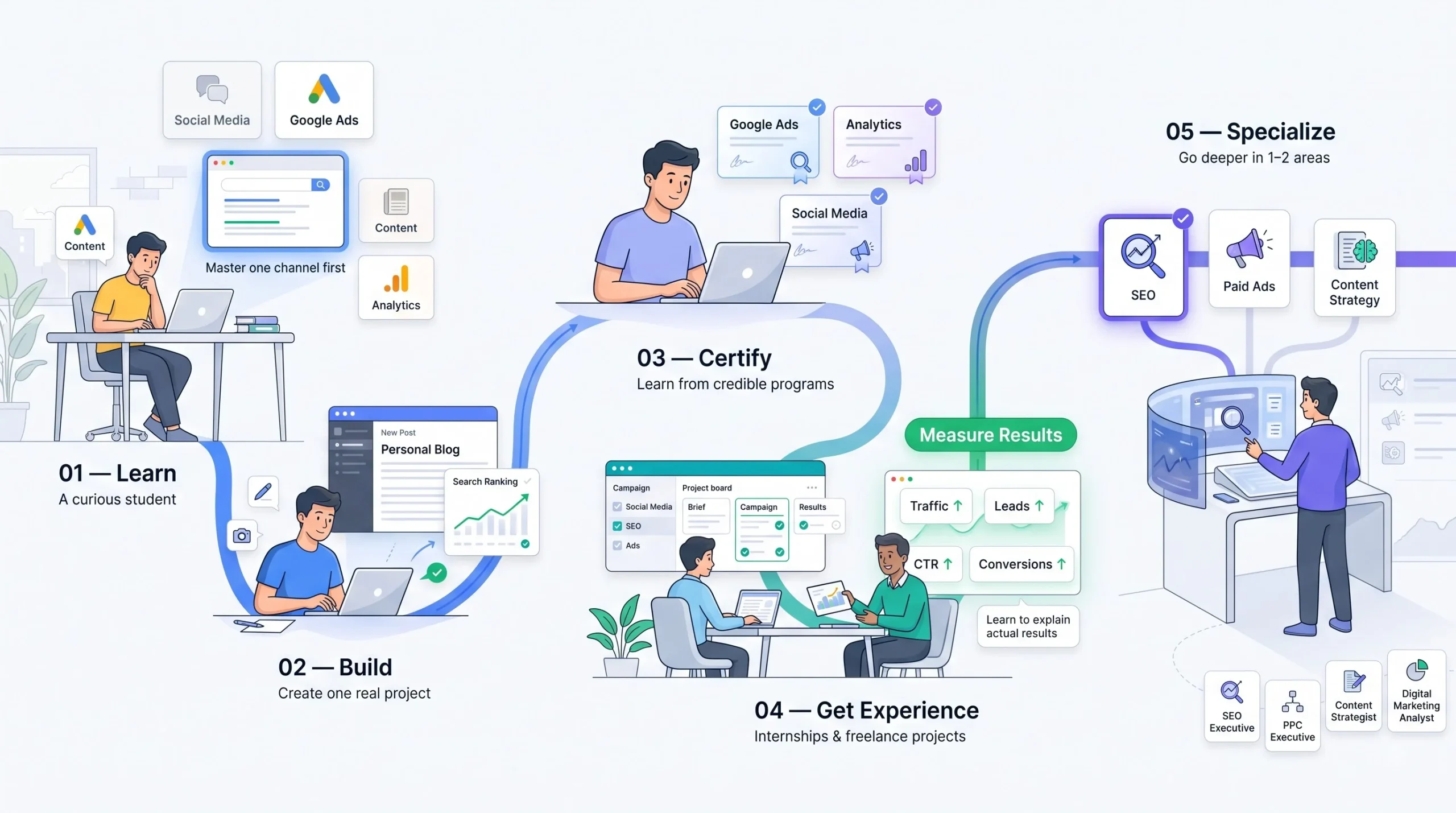
Here’s a roadmap that actually works, not just advice to “learn everything,” which helps nobody.
Start with fundamentals. This guide is a starting point, but pick one channel, SEO or social media tends to be the most approachable, and go one level deeper than the surface. Understanding one channel properly beats knowing five channels superficially.
Build one small project. Theory without practice doesn’t hold up in an interview. Start a personal blog and try ranking a single post on Google. Run a college fest’s Instagram page. Offer to manage social media for a friend’s small shop, even for free initially, just to have something real to point to.
Get certified through free, credible programs. Google offers free certifications through Skillshop covering Google Ads and Analytics. Meta offers Meta Blueprint for Facebook and Instagram advertising. HubSpot Academy offers free certifications in content marketing, email marketing, and inbound strategy. These aren’t just resume filler, they teach the actual mechanics of the platforms being used in real jobs.
Apply skills through internships or small freelance projects. Local businesses, especially in Tier-2 and Tier-3 cities, are often under-marketed and open to a student handling their Instagram or basic SEO for a modest fee or even for the experience alone. That real-world messiness, dealing with an actual client, actual deadlines, actual results that need explaining, teaches more in a month than a course does in three.
Eventually, specialize. Nobody stays a generalist forever in this field. Someone gravitates toward SEO because they like the analytical, puzzle-solving nature of it. Someone else prefers paid ads because they like the immediacy of seeing a campaign perform in real time. Someone else loves writing and ends up in content strategy. That’s normal, and expected.
| Skill | Where to Start Learning It Free | What It Prepares You For |
|---|---|---|
| SEO | Google Search Console Help, Search Engine Journal | SEO Executive, Content Strategist roles |
| Google Ads / PPC | Google Skillshop (Google Ads certification) | PPC Executive, Performance Marketing roles |
| Social Media Ads | Meta Blueprint | Social Media Executive, Paid Social roles |
| Email Marketing | HubSpot Academy (Email Marketing certification) | Email Marketing Executive, CRM roles |
| Analytics | Google Analytics Academy | Digital Marketing Analyst roles |
| Content Writing | HubSpot Academy (Content Marketing certification) | Content Writer, Content Strategist roles |
Nobody needs to master every channel before applying for a first job. Most working professionals specialize in one or two areas and stay just aware enough of the rest to collaborate with other teams.
Career Paths in Online Marketing (India-Focused)
Real numbers matter here, not vague reassurance that “marketing is a good career.” Entry-level pay in this field in India tends to start modestly and climbs fast with actual experience and results, which is fairly different from fields where pay stays flat for years regardless of performance.
| Role | What They Actually Do | Typical Starting Salary Range | Key Skill Needed |
|---|---|---|---|
| SEO Executive | Keyword research, on-page optimization, basic link building | ₹15,000–₹25,000/month | Attention to detail, patience for slow-building results |
| PPC/Ads Executive | Setting up and managing Google/Meta ad campaigns | ₹15,000–₹28,000/month | Comfort with numbers, budget management |
| Social Media Executive | Content calendars, posting, community engagement | ₹12,000–₹22,000/month | Creativity, consistency, platform awareness |
| Content Writer/Strategist | Writing blogs, planning content around SEO and audience needs | ₹15,000–₹25,000/month | Strong writing, research ability |
| Email Marketing Executive | Building email campaigns, segmenting lists, tracking opens | ₹15,000–₹25,000/month | Writing plus basic automation tool skills |
| Digital Marketing Analyst | Tracking performance across channels, building reports | ₹18,000–₹30,000/month | Comfort with data and spreadsheets |
These numbers shift depending on city, company size, and whether it’s an agency or an in-house brand role. Bengaluru and Mumbai tend to pay more than smaller cities. Agencies often pay slightly less starting out but offer exposure to more clients and channels in less time, which speeds up learning. In-house roles at a single brand pay a bit more on average but the work stays narrower.
The growth path from there tends to follow a fairly predictable arc. Executive roles for the first one to two years, where the work is mostly execution, running campaigns someone else strategized. Specialist roles after that, usually two to four years in, where independent strategy work starts. Manager roles after that, overseeing a team and owning results across multiple campaigns. And eventually, five to eight years in, roles like Head of Marketing or Marketing Director, owning the entire strategy for a brand or business. That timeline compresses fast for people who actually show measurable results early, which is one of the genuine advantages of a field this trackable. Nobody’s waiting for a performance review cycle to prove their work mattered, the numbers show it in real time.
Common Myths About Online Marketing
Myth: It’s just posting on Instagram. Reality: Posting is maybe 10% of the actual work. The rest is strategy, understanding an audience, writing copy that converts, analyzing what’s working and what isn’t, and adjusting constantly. A brand’s Instagram page looking effortless usually means someone spent hours planning what looks effortless.
Myth: SEO gives instant results. Reality: SEO is closer to compound interest than a lottery ticket. Most SEO campaigns need three to six months before rankings move meaningfully, sometimes longer for competitive keywords. Anyone promising first-page rankings in a week is either lying or doing something that’ll get the website penalized later.
Myth: A huge budget is required to start. Reality: Some of the best learning happens with zero budget. A free blog, an organic Instagram page, a YouTube channel, none of these need ad spend to start building real, provable skills.
Myth: It’s only for tech-savvy people. Reality: Curiosity and consistency matter far more than technical background. Plenty of successful marketers come from writing, psychology, or business backgrounds with no coding knowledge at all. The tools do get learned along the way, not before starting.
A Quick Example: Online Marketing in Action
Take a fictional example, a small online education brand offering digital marketing courses, similar in spirit to plenty of real institutes operating right now.
It starts with a blog post targeting a search term like “what is online marketing,” ranking on Google over a few months through consistent SEO work, that’s the awareness stage, pulling in students who are just starting to explore the field. Some of those readers aren’t ready to enroll yet, so an email signup offering a free beginner’s guide captures their interest, that’s the consideration stage, nurturing them with a few follow-up emails over the next couple of weeks. Meanwhile, the same brand runs Instagram Reels showing quick tips and student success stories, building trust and staying visible to people who haven’t converted yet. Eventually, a small percentage of that nurtured audience lands on a course page, and for anyone who visited that page but didn’t enroll, a retargeting ad on Google or Instagram reminds them the course still exists, often with a small nudge like a limited-time discount, that’s the conversion stage.
No single channel did all the work. SEO brought people in. Email nurtured them. Social media kept the brand visible. PPC closed the deal. That’s what “online marketing” actually looks like when it’s working properly, several channels handing off to each other rather than one channel trying to do everything alone.
Conclusion
Online marketing isn’t complicated once it’s broken into pieces. It’s the practice of reaching people through the internet, and it works through a handful of channels, SEO, PPC, social, content, email, and a few others, that each play a different role depending on whether someone’s just discovering a brand or ready to buy from it. None of it requires a business degree or a huge budget to start learning. What it requires is picking one channel, actually practicing it on something real, even something small, and getting comfortable with the numbers that prove whether it’s working.
This field rewards people who stay curious and keep showing up more than it rewards a fancy résumé. A student starting today with nothing but a laptop and genuine interest has a real shot at building a career here, faster than in most other fields. The next step is simple: pick one channel from this guide, and go deeper.
Frequently Asked Questions
What is online marketing in simple words?
It’s promoting a product, service, or brand using the internet, websites, search engines, social media, email, whatever channel gets in front of the right person. The whole point is reaching people who might actually care, then measuring whether that reach turned into an action.
What is the difference between online marketing and digital marketing?
Digital marketing is the bigger umbrella, it covers anything using digital technology, including things that don’t need the internet, like SMS campaigns or digital billboards. Online marketing sits inside that umbrella and specifically means internet-based promotion, SEO, Google Ads, social media, email. In everyday conversation people use both terms to mean the same thing, but technically online marketing is the narrower slice.
Do I need a degree to work in online marketing?
No. Most entry-level roles care more about a portfolio, some hands-on project, a certification, a small campaign that actually ran, than a specific degree. Plenty of people working in this field studied something completely unrelated, English literature, engineering, commerce, and picked up marketing skills separately.
Which online marketing skill should a beginner learn first?
SEO or social media tend to be the most approachable starting points, since both can be practiced with zero budget. SEO teaches patience and how search engines actually think. Social media teaches content and audience instincts fast, since feedback (likes, comments, shares) shows up almost immediately.
Is SEO or Google Ads better for beginners to learn?
Neither is objectively better, they solve different problems. SEO takes longer to show results but doesn’t need a daily budget, which makes it easier to practice as a student with no money to spend. Google Ads shows results faster but needs an actual budget to run real campaigns, even a small one. Learning both eventually matters more than picking a side early.
How much does an entry-level digital marketing job pay in India?
Most entry-level roles, SEO Executive, Social Media Executive, Content Writer, start somewhere around ₹12,000 to ₹25,000 a month, depending on the city, the company, and whether it’s an agency or an in-house brand role. That climbs fairly quickly, often 20 to 40% within the first one to two years, for people who can actually show measurable results.
Can online marketing be learned for free?
Yes, largely. Google Skillshop, Meta Blueprint, and HubSpot Academy all offer free certifications covering the core mechanics of ads, analytics, and content strategy. Beyond that, a free blog or an Instagram page is enough to start practicing, no paid course is required to begin learning.
What is the marketing funnel and why does it matter?
It’s the path someone takes from not knowing a brand exists to becoming a paying customer, usually broken into awareness, consideration, and conversion stages. It matters because different channels do different jobs at each stage. Running a hard sales pitch at someone who’s never heard of the brand before, that’s a mismatch, and it’s one of the most common reasons campaigns fail to convert.
What tools do online marketers actually use daily?
Google Analytics and Google Search Console for tracking traffic and rankings, Canva for quick design work, Mailchimp or similar tools for email campaigns, and a scheduling tool like Buffer or Later for social media. None of these are complicated to learn, most have free versions good enough to practice on.
Is online marketing a good career option for students in India right now?
It’s one of the more accessible ones. Low barrier to entry, no mandatory degree, real demand from businesses shifting budgets from traditional to digital, and a genuine path to specialize and grow pay within a couple of years based on actual performance rather than seniority alone.
What is the difference between paid and organic marketing?
Organic is visibility earned without directly paying for placement, ranking on Google, growing followers through consistent posting. Paid is visibility bought directly, running ads, boosting posts. Organic takes longer but keeps working after the effort stops. Paid works instantly but stops the moment the budget does.
How long does it take to see results from online marketing?
Depends entirely on the channel. Paid ads can bring clicks within hours of going live. SEO usually needs three to six months before rankings move in any meaningful way. Social media growth and email marketing tend to land somewhere in between, weeks to a couple of months of consistent effort before real traction shows up.