

You’ve probably typed some version of this question into Google late at night: “how much does digital marketing cost?” Maybe you got a quote from an agency that made your stomach drop. Maybe a freelancer quoted you a third of that price and now you’re confused about why the gap is so huge. Or maybe you’re just trying to figure out if ₹15,000 a month is enough to get your business noticed online, or if you’re about to waste it.
Here’s the honest answer, and it’s not the one most agency websites will give you: there is no fixed price for digital marketing. Anyone who gives you one number without asking a dozen questions first is either guessing or trying to close a sale fast. The real cost depends on your business size, your industry, how competitive your market is, where your customers live, what you’re trying to achieve, and whether you’re doing this in-house, with freelancers, or through an agency. Two businesses making the same revenue can have wildly different marketing budgets, and both can be right for their situation.
This guide isn’t going to hand you a single magic number. Instead, it’s going to walk you through how digital marketing pricing actually works, what different business sizes typically spend, what each service costs on its own, and how to figure out what makes sense for you specifically. Spending more money doesn’t automatically mean better results, and spending less doesn’t automatically mean worse ones. What matters is spending on the right things, in the right order, for where your business actually is right now.
What You Will Learn in This Guide
- What digital marketing typically costs across different business sizes, from solo founders to enterprises
- What’s actually included when someone quotes you a “digital marketing package”
- The biggest factors that push your cost up or down
- How SEO, PPC, social media, content, and email marketing are priced individually
- The real difference between agency fees, freelancer rates, and building an in-house team
- A practical framework to calculate your own budget instead of copying someone else’s
- Real budget examples for different business types, from restaurants to SaaS companies
- What digital marketing costs in India specifically, including tier-2 and tier-3 city pricing
- Hidden costs almost everyone forgets to budget for
- How to tell if you’re overspending or underspending
- The metrics that actually tell you whether your spend is working
- Answers to the most common questions business owners ask about marketing costs
Digital Marketing Cost at a Glance
Before we get into the reasoning behind all of this, let’s just look at some numbers. This table gives you a rough starting point. Don’t treat it as gospel, treat it as a compass.
| Business Size | Typical Monthly Budget | Main Focus |
|---|---|---|
| Solopreneur | ₹5,000–₹20,000 | SEO, content, social media |
| Small Business | ₹15,000–₹50,000 | SEO, social media, local marketing |
| Growing Startup | ₹30,000–₹1,00,000 | SEO, paid ads, content, lead generation |
| Mid-Sized Business | ₹75,000–₹3,00,000+ | Multi-channel marketing |
| Enterprise | ₹2,00,000–₹10,00,000+ | Integrated digital marketing |
These ranges are indicative, not universal. A solopreneur selling premium consulting services in Mumbai might need a bigger budget than a small manufacturing business in a tier-3 city, even though the manufacturing business makes more money. Why? Because the consultant is competing for attention in a crowded, high-CPC market, while the manufacturer might get most of its business through referrals and just needs a decent website and some local visibility.
Also worth flagging early: these numbers usually don’t include everything. Ad spend, software subscriptions, creative production, and website development are often separate line items from whatever an agency or freelancer charges for their service fee. A business that thinks it’s spending ₹30,000 a month on marketing might actually be spending ₹45,000 once you add in the Google Ads budget, a stock photo subscription, and an email marketing tool. We’ll get into all of that later.
What Is Included in Digital Marketing?
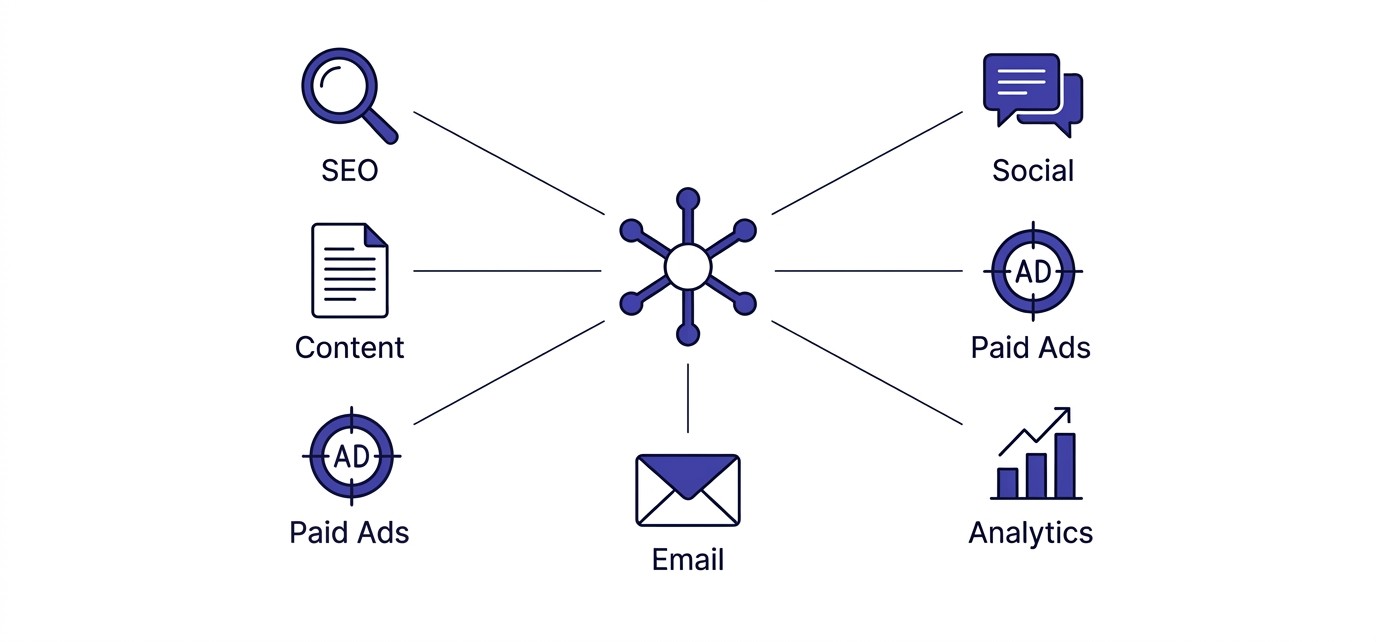
Before anyone can tell you what something costs, you need to know what you’re actually buying. “Digital marketing” is a broad umbrella term, and different businesses need different slices of it. Let’s break down what actually falls under this category.
Search Engine Optimization (SEO)
SEO covers technical SEO (fixing site speed, crawlability, mobile issues), keyword research, on-page SEO (titles, meta descriptions, headers), content creation built around search intent, internal linking, link building, local SEO for businesses with a physical presence, and the reporting that shows whether any of it is working. SEO is a long game. Nobody ranks on page one in three weeks, no matter what a sales pitch tells you.
Search Engine Marketing / PPC
This is paid search: Google Ads, Bing Ads, search campaigns, display campaigns, remarketing to people who already visited your site, and shopping campaigns for e-commerce businesses. PPC is fast. You can get traffic today. But the moment you stop paying, the traffic stops too. That’s the trade-off nobody explains clearly enough.
Social Media Marketing
This includes managing Instagram, Facebook, LinkedIn, and YouTube, creating content for each platform, community management (replying to comments and DMs, not just posting), and paid social advertising. A lot of businesses think social media marketing means “posting sometimes.” It’s actually a lot more work than that if you’re doing it properly.
Content Marketing
Blog posts, landing pages, case studies, whitepapers, videos, infographics, and lead magnets all fall under content marketing. This is the fuel behind SEO and social media both. Without content, your SEO strategy has nothing to rank and your social channels have nothing to post.
Email Marketing
Newsletter campaigns, lead nurturing sequences, automation flows, promotional emails, and customer retention campaigns. Email gets ignored by a lot of small businesses, which is a mistake, because it’s usually the cheapest channel with the best return once your list is built.
Website and Conversion Optimization
Website improvements, dedicated landing pages, conversion rate optimization (CRO), UX improvements, and analytics setup. You can drive a thousand visitors to a site, but if the site is confusing or slow, none of that traffic turns into customers.
Analytics and Reporting
GA4 setup, Google Search Console, conversion tracking, dashboard creation, and campaign reporting. This is the unglamorous part nobody talks about, but it’s the only way to know if any of the above is actually working.
The Biggest Factors That Determine Digital Marketing Cost
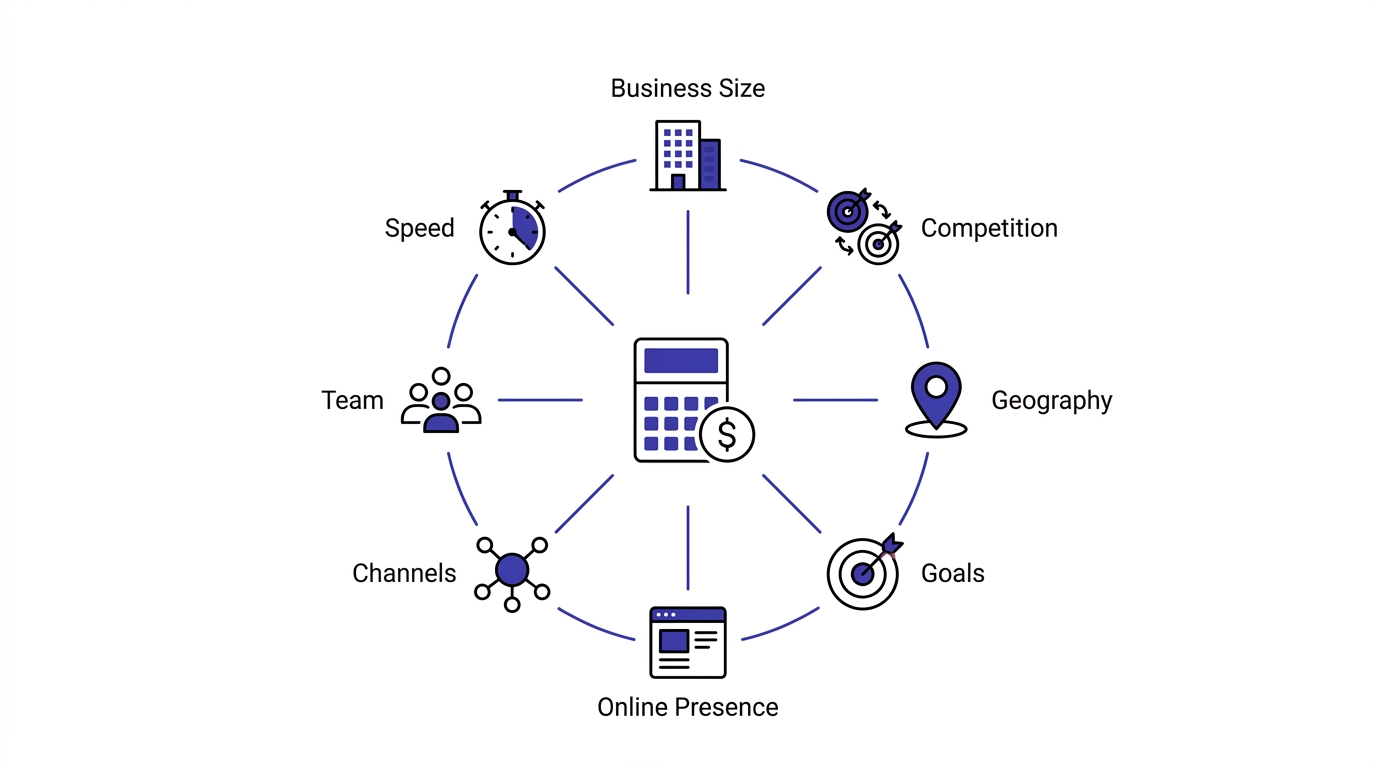
So why does one business pay ₹20,000 and another pays ₹2,00,000 for what sounds like the same service? Here’s the logic behind the pricing.
Business Size and Revenue
Bigger businesses generally need broader campaigns because they have more products, more locations, or more customer segments to reach. But revenue and marketing budget aren’t the same thing. A ₹5 crore business with thin margins might spend less on marketing than a ₹2 crore business in a high-margin niche that can afford to invest aggressively in growth.
Industry Competition
Some industries are just brutal to market in. Real estate, healthcare, finance, SaaS, e-commerce, education, and legal services all have high competition, which pushes up the cost of ranking on Google or running profitable ad campaigns. If you’re a lawyer in Delhi bidding on “divorce lawyer near me,” you’re competing against dozens of other firms, and that cost-per-click adds up fast. A niche hobby brand with almost no direct competitors online has a much easier, cheaper road.
Target Geography
Local marketing for a single shop costs a fraction of what a national campaign costs. City-level campaigns sit somewhere in between, and international campaigns are their own beast entirely, often requiring localized content, multiple currencies, and region-specific ad strategies. The wider your target geography, the more budget you need to cover it properly.
Marketing Goals
Brand awareness campaigns, driving website traffic, generating leads, closing sales, getting app downloads, boosting e-commerce revenue, and improving customer retention all require different strategies and different spend levels. A goal like “we want people to recognize our brand” is expensive and slow. A goal like “we want 50 qualified leads this month” is more measurable but often needs a bigger paid media push to hit fast.
Current Online Presence
A brand-new website with zero domain authority starts from scratch. An established website with existing rankings, decent domain authority, an active social following, and a real customer database has a massive head start. Businesses starting from zero usually need to spend more upfront just to catch up to where competitors already are.
Number of Marketing Channels
SEO-only campaigns cost less than a full-stack strategy running SEO, Google Ads, social media, content, and email all at once. Every additional channel adds work, adds tools, and adds cost. This is one of the biggest reasons budgets vary so much between businesses that look similar on paper.
In-House vs Outsourcing
Hiring full-time employees, working with freelancers, hiring an agency, or building a hybrid team all come with very different cost structures, which we’ll dig into in detail later in this guide.
Speed of Expected Results
Organic growth through SEO and content is cheaper over time but slower to show up. Paid acquisition is faster but keeps costing money as long as you want the results to continue. Short-term campaigns built for a launch or a sale cost differently than long-term brand building that plays out over years. If you need results in 30 days, expect to pay more for that speed.
Digital Marketing Cost by Business Size
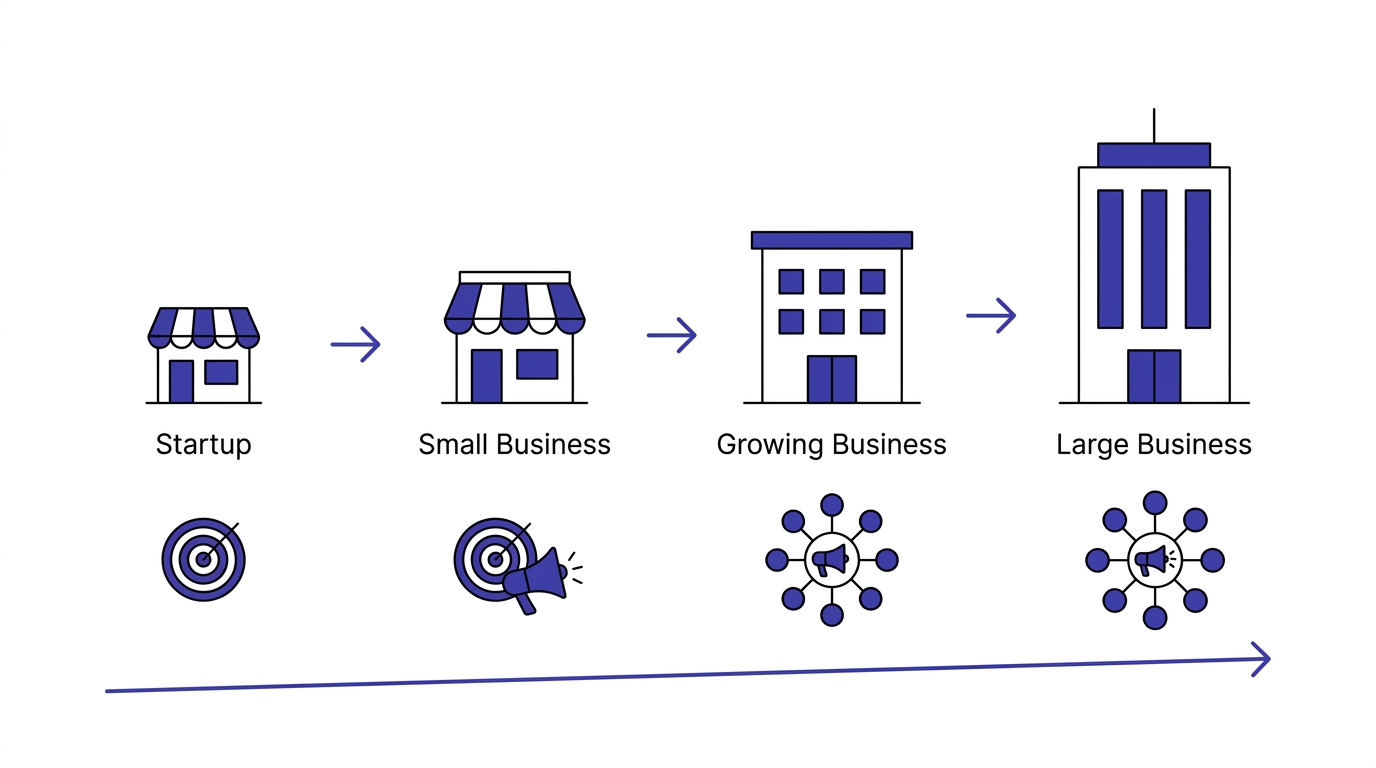
Let’s get specific now. Here’s what businesses at each stage typically spend, and what that spend actually buys them.
Digital Marketing Budget for Solopreneurs
Typical budget: ₹5,000–₹20,000/month
If you’re running a business by yourself, your budget is tight and every rupee has to earn its place. The channels that make the most sense at this stage are local SEO, basic SEO, social media, content marketing, WhatsApp marketing, and optimizing your Google Business Profile. These channels are either free or low-cost and don’t require a big team to execute.
With a small budget, what’s realistically achievable is a basic but functional online presence, decent local visibility if you serve a specific area, consistent content that slowly builds authority, some initial organic traffic, and early-stage lead generation. Don’t expect viral growth or page-one rankings for competitive keywords with ₹10,000 a month. That’s not how this works.
A sample allocation for a ₹14,000 monthly budget might look like this: SEO and content around ₹5,000, social media management around ₹3,000, tools and software around ₹1,000, and paid advertising around ₹5,000. This isn’t a rigid formula, just a realistic starting point.
Solopreneurs should think about increasing their budget once they start seeing consistent inbound interest they can’t fully act on, once they’ve validated which channel is actually converting, or once they have more revenue to reinvest. Don’t scale spend just because it feels like the “next step.” Scale it because the data tells you to.
Digital Marketing Budget for Small Businesses
Typical budget: ₹15,000–₹50,000/month
Small businesses usually have a bit more room to work with, and the recommended channels expand a little: local SEO, Google Business Profile optimization, broader SEO, social media, Google Ads, and content marketing. This is the point where paid advertising starts to make more sense because there’s enough budget to actually run a meaningful test.
A sample ₹30,000 monthly budget might break down as SEO and content at ₹10,000, social media at ₹6,000, Google Ads spend at ₹10,000, and tools plus miscellaneous costs at ₹4,000. The objectives at this stage are usually generating local leads, increasing website traffic, improving search visibility, and building some brand credibility in the local market.
The mistakes small businesses make at this budget level are painfully common. Spending everything on ads and nothing on SEO means you’re renting attention instead of owning it. Ignoring SEO entirely means you’re always paying for traffic instead of earning some of it for free over time. Posting on social media without any real strategy wastes time and produces nothing measurable. Hiring too many vendors for too small a budget spreads everyone thin and nobody does a great job. And not tracking conversions means you genuinely have no idea if any of this is working, you’re just hoping.
Digital Marketing Budget for Startups
Typical budget: ₹30,000–₹1,00,000+/month
Startups sit in an interesting spot. There’s usually pressure to grow fast, sometimes because of investor expectations, sometimes because of a competitive window that won’t stay open forever. The recommended focus areas are SEO, paid acquisition, content, social media, landing pages, and conversion optimization.
A sample ₹75,000 monthly budget could look like SEO at ₹15,000, paid ads spend at ₹35,000, content production at ₹12,000, social media at ₹8,000, and tools plus CRO work at ₹5,000. Notice how paid acquisition gets the biggest slice here, that’s intentional for this stage.
Startups should prioritize paid advertising when they need fast validation of a product-market fit signal, when there’s a funding-driven growth target to hit, or when a competitor is eating market share quickly and organic growth alone won’t catch up in time. Startups should prioritize SEO when they’re building for the long term, when their category has searchable demand that hasn’t been captured yet, or when paid channels are getting too expensive to sustain.
To avoid burning through the budget, startups should test small before scaling any campaign, resist the urge to be on every platform at once, and set a hard stop-loss on underperforming campaigns instead of letting them run “just a bit longer” out of hope.
Digital Marketing Budget for Mid-Sized Businesses
Typical budget: ₹75,000–₹3,00,000+/month
At this stage, businesses typically need multi-channel campaigns, dedicated SEO work, paid search, social advertising, real content production, marketing automation, and proper analytics. This isn’t a side project anymore, it’s an operating function of the business.
An example monthly allocation for a ₹2,00,000 budget might be SEO at ₹30,000, paid media at ₹80,000, content production at ₹30,000, social media at ₹25,000, creative work at ₹15,000, tools at ₹10,000, and CRO at ₹10,000. Mid-sized businesses need a more integrated strategy because their customer journey usually spans multiple touchpoints. Someone might discover them through a social ad, research them through organic search, and finally convert after seeing a retargeting ad. Each channel needs to support the others, not operate in isolation.
Digital Marketing Budget for Large Businesses and Enterprises
Typical budget: ₹2,00,000–₹10,00,000+/month
Enterprise marketing operates on a different scale entirely. There might be multiple product lines to market separately, multiple physical locations to promote, national or international campaigns running simultaneously, large paid media budgets, enterprise-grade SEO across huge websites, marketing automation platforms, advanced analytics setups, video production, influencer campaigns, and dedicated brand campaigns.
The cost structure at this level should be broken down clearly: agency fees for strategy and execution, media spend for the actual advertising, technology costs for the platforms and tools being used, content production costs, and internal team costs for whoever is managing all of this on the business side. Enterprise budgets reach several lakhs a month because the scope of work is genuinely that much bigger, not because enterprises are being overcharged. Managing campaigns across ten cities with five product lines is a fundamentally different job than managing one local shop’s Google Business Profile.
Digital Marketing Cost by Service
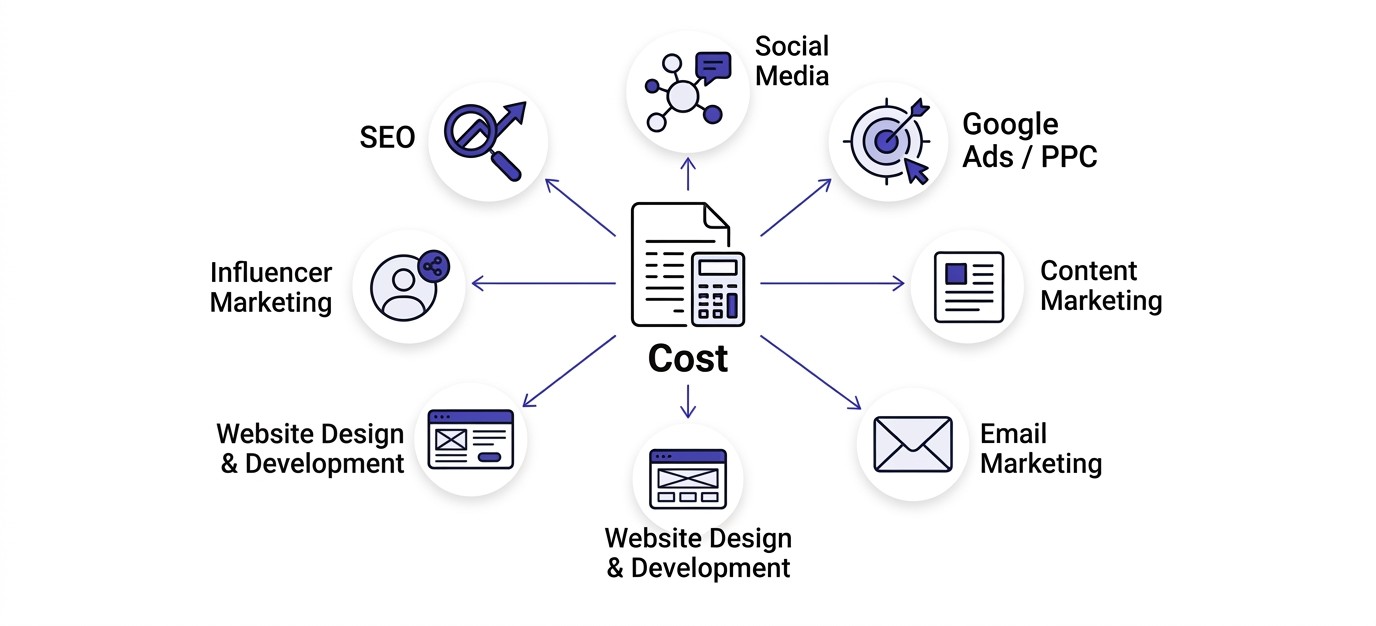
Now let’s zoom in and look at what individual services actually cost, since most businesses don’t buy “digital marketing” as a single blob, they buy specific services.
SEO Cost
SEO can be handled by a freelancer, an SEO agency, or done through in-house hires, and pricing varies a lot depending on which route you take. Local SEO for a single business location costs less than national SEO targeting broad, competitive keywords, and enterprise SEO for large websites with thousands of pages costs the most of all.
Pricing models for SEO usually fall into a few buckets: monthly retainers where you pay a fixed fee for ongoing work, project-based pricing for a specific deliverable like a technical audit, hourly pricing for smaller ad hoc tasks, and performance-based pricing where fees are tied to ranking improvements or traffic growth. What determines the actual number is the competitiveness of your keywords, the current state of your website, how many pages need work, and how aggressive your growth targets are.
Social Media Marketing Cost
Pricing here covers social media management (planning and posting), content creation, reels and short-form video, graphic design, community management, and paid social advertising on top of all that. A basic management package covering two platforms with a handful of posts a week costs far less than a full content operation producing daily reels, running community engagement, and managing a growing ad budget. Monthly social media budgets can realistically range from a few thousand rupees for a bare-bones setup to well over a lakh for a brand running heavy video content and paid promotion.
Google Ads / PPC Cost
This is one of the most misunderstood cost categories, so let’s be really clear about it. There are two separate numbers here: the management fee (what you pay a freelancer or agency to run your campaigns) and the ad spend (what you pay Google directly for clicks and impressions). These are not the same thing, and a lot of business owners get confused when a quote says “₹50,000 for Google Ads.”
Key terms to understand: CPC (cost per click, what you pay each time someone clicks your ad), CPA (cost per acquisition, what it costs to get one conversion), ROAS (return on ad spend, how much revenue you generate for every rupee spent), and your daily budget, which is the cap on what Google can spend on your behalf each day.
Here’s a concrete example. If a business spends ₹50,000 on Google Ads, that entire amount goes to Google as media spend. The agency or freelancer managing that campaign charges a separate fee on top, often either a flat retainer or a percentage of ad spend. This distinction matters because a lot of businesses think their “marketing cost” is just the retainer they’re paying, without realizing the ad spend itself is a whole separate, often larger, expense.
Content Marketing Cost
Blog writing, SEO articles, landing page copy, case studies, whitepapers, and video content all have different price points, and quality varies enormously within each category. A generic, keyword-stuffed 500-word article costs a fraction of what a well-researched, genuinely useful 2,000-word guide costs, because the second one requires real subject matter expertise, editing, and time. Businesses that go for the cheapest content option often end up publishing stuff nobody wants to read, which defeats the entire point of content marketing.
Email Marketing Cost
This includes the email software subscription itself, initial setup and list migration, ongoing campaign management, automation flow building, copywriting for each email, and database management to keep your list clean and segmented properly. Email is often the most cost-effective channel per rupee spent, especially once your list is established, because you’re marketing to people who already opted in and already know your brand.
Website Design and Development Cost
Your website is the foundation everything else points back to, so its cost directly affects your marketing results too. A basic business website costs less than an e-commerce website with product catalogs, payment gateways, and inventory syncing. Dedicated landing pages for specific campaigns add cost but usually pay for themselves through better conversion rates. Website redesigns and conversion optimization work are ongoing investments, not one-time expenses, because what converts well today might not convert as well a year from now as design trends and user expectations shift.
Influencer Marketing Cost
Pricing varies wildly here based on the influencer’s tier. Micro influencers (smaller, highly engaged followings) are the most affordable and often deliver the best engagement-per-rupee. Mid-tier influencers cost more but offer broader reach. Macro influencers and celebrity influencers command the highest fees and are usually reserved for brand awareness campaigns rather than direct-response marketing. Beyond audience size, pricing also depends on engagement rate, the industry being marketed, the content format requested (a single post versus a full video series), and the platform itself, since Instagram, YouTube, and LinkedIn all have different rate expectations.
Digital Marketing Pricing Models Explained
Understanding how you’re being charged is just as important as understanding what you’re being charged for.
Monthly Retainer
You pay a fixed fee every month for an agreed scope of ongoing work. This is the most common model for SEO, social media management, and general marketing support. The advantage is predictability, both for you and the person you’re working with. The disadvantage is that if your needs shrink one month, you’re still paying the same fixed amount. Retainers work best for businesses that need consistent, ongoing marketing activity rather than one-off projects.
Project-Based Pricing
You pay a set fee for a defined deliverable, like a website SEO audit, a full website redesign, an SEO migration when you’re changing platforms, or a specific content project. This works well when you know exactly what you need and don’t want an ongoing commitment. The downside is that scope creep is common, so make sure the deliverables are written down clearly before work starts.
Hourly Pricing
You pay for actual hours worked. This makes sense for smaller, unpredictable tasks where a retainer or project fee doesn’t fit well, like occasional consulting or troubleshooting. The limitation is that it’s hard to budget for and doesn’t incentivize efficiency the way other models do, since more hours means more revenue for whoever’s billing you.
Performance-Based Pricing
Fees are tied to results, like a percentage of increased revenue or a fee per qualified lead generated. This sounds appealing because it feels lower-risk, but read the agreement carefully. What counts as a “result”? Over what timeframe? Are there minimum baseline fees regardless of performance? Performance-based deals can work well when defined clearly, but vague ones often lead to disputes about what actually counts as a win.
Percentage of Ad Spend
Common for PPC management, where the agency charges a percentage of whatever you’re spending on ads, often somewhere between 10-20%. This aligns their incentive with growing your ad spend, which isn’t always the same as growing your results, so it’s worth watching closely.
Which pricing model is best for your business?
| Model | Best For | Watch Out For |
|---|---|---|
| Monthly Retainer | Ongoing, consistent work | Paying the same fee during slow months |
| Project-Based | One-off, clearly defined work | Scope creep |
| Hourly | Small, unpredictable tasks | Hard to budget, less efficiency incentive |
| Performance-Based | Results-focused engagements | Vague definitions of “results” |
| % of Ad Spend | PPC management | Incentive to inflate ad spend |
Agency vs Freelancer vs In-House Digital Marketing Cost
This decision affects your budget more than almost anything else, so let’s actually break it down.
Hiring a Freelancer
Freelancers typically cost less than agencies because they have lower overhead, no office space, no account managers, no layers of staff between you and the work. They’re well suited for focused tasks like writing blog content, managing a single social channel, or running a specific PPC campaign.
The pros: freelancers are generally more affordable, more flexible with scope changes, and you communicate directly with the person doing the actual work instead of going through a middleman. The cons: they have limited capacity, since one person can only do so much, you’re dependent on a single individual (if they get sick or busy, your marketing stalls), and they may lack specialized expertise across every channel you need, since nobody is equally strong at SEO, design, and paid ads all at once.
Hiring a Digital Marketing Agency
Agencies typically cost more than individual freelancers because you’re paying for a team, not a person, and that team usually covers broader service coverage across multiple channels at once. The pros: you get access to multiple specialists under one roof, a combination of strategy and execution, the ability to scale up or down as needs change, and structured reporting. The cons: higher cost overall, more communication layers between you and the people doing the work, and contract commitments that can lock you in for a minimum period.
Building an In-House Team
This is where a lot of businesses underestimate the true cost. Beyond salary, you’re also paying for software and tools, employee benefits, training, and management overhead. A realistic in-house team might include an SEO specialist, a content writer, a social media manager, a PPC specialist, a designer, and a marketing manager to oversee it all.
A hypothetical monthly calculation for a lean in-house team might land somewhere around ₹1,50,000–₹3,00,000+ once you add up salaries for two or three marketing roles, plus tool subscriptions, plus the management time it takes to run the function properly. This is usually only worth it once your marketing needs are consistent and large enough to justify full-time headcount rather than flexible outside help.
Hybrid Model
A lot of growing businesses land here eventually: an internal marketing manager who sets strategy and owns the relationship, combined with freelancers for specific skills and specialized agencies for complex channels like PPC or SEO that need dedicated expertise. This model often offers the best value because you get strategic continuity from the in-house person while still accessing specialist skill without the cost of hiring five different full-time roles.
How Much Should a Business Spend on Digital Marketing?
This is the question everyone actually wants answered, so let’s tackle it directly.
Percentage of Revenue Approach
One common way businesses think about this is allocating a percentage of revenue toward marketing. You’ll hear different numbers thrown around depending on who you ask and what industry you’re in. There’s no single universal percentage that applies to every business, and treating any one number as a rule is a mistake. A business in a fast-growth phase trying to capture market share often spends a higher percentage than a stable, established business that’s mostly focused on retention.
Goal-Based Budgeting
Here’s a better way to think about it than just picking a percentage out of thin air. Instead of starting with “how much can I spend?”, start with “how many customers do I need?” Then work backward from that number to figure out what it’ll actually take to get there. This flips the whole exercise from a vague guess into a calculation you can actually defend.
How to Calculate Your Digital Marketing Budget
Let’s actually walk through this step by step, with a practical example.
Step 1: Define Your Revenue Goal
Say your current monthly revenue is ₹5,00,000 and your target is ₹7,00,000. That means you need an additional ₹2,00,000 in revenue to hit your goal.
Step 2: Determine Customer Value
Calculate your average order value and, if relevant, your customer lifetime value. If your average order value is ₹5,000, that additional ₹2,00,000 in revenue means you need roughly 40 new orders.
Step 3: Determine Your Target Customers
Figure out how many new customers you actually need, and factor in your lead-to-customer conversion rate. If your conversion rate from lead to customer is 20%, you’d need around 200 leads to get those 40 customers.
Step 4: Calculate Required Leads
Using the numbers above, you now know you need approximately 200 leads this month to hit your revenue target. This number becomes your north star for the rest of the calculation.
Step 5: Estimate Customer Acquisition Cost
Look at your historical data, or industry benchmarks if you’re just starting out, to estimate what it costs to acquire one customer through your chosen channels. Say your estimated cost per lead is ₹300.
Step 6: Determine Marketing Investment
200 leads multiplied by ₹300 per lead gives you a required marketing investment of roughly ₹60,000 for that specific push, not counting the retainer or management fee for whoever’s running the campaigns.
Step 7: Allocate the Budget Across Channels
Finally, spread that ₹60,000 across the channels most likely to deliver those leads efficiently. Maybe ₹35,000 goes to Google Ads, ₹15,000 to social media advertising, and ₹10,000 to content and SEO support. This isn’t guesswork anymore, it’s tied directly to a number you actually need to hit.
Digital Marketing Budget Examples by Business Type
Numbers land differently depending on what kind of business you’re running, so here’s how this plays out across a few common types.
Local Restaurant
A restaurant’s budget usually leans heavily on Google Business Profile optimization and local SEO, since most people searching for “restaurants near me” convert fast if the listing looks good. Social media matters a lot here too, especially food photography and short videos. A modest Google Ads budget for high-intent local searches rounds this out, along with occasional content around menu updates or events.
Real Estate Business
Real estate needs strong SEO for property-related searches, Google Ads for high-intent buyer and renter searches, Meta Ads for broader awareness and retargeting people who viewed listings, dedicated landing pages for individual properties or projects, and consistent content covering neighborhood guides and market updates.
E-Commerce Business
E-commerce budgets typically prioritize Google Shopping ads since they show products directly in search results, Meta Ads for discovery and retargeting, SEO for organic product and category page visibility, email marketing for cart abandonment and repeat purchases, and retargeting campaigns to bring back visitors who didn’t convert the first time.
SaaS Company
SaaS businesses need SEO built around problem-aware and solution-aware search terms, in-depth content that builds trust with a technical or business audience, Google Ads for high-intent bottom-of-funnel searches, LinkedIn for B2B targeting, email nurture sequences for long sales cycles, and conversion optimization since SaaS trials and demos live and die by landing page clarity.
Professional Services Business
Consultants, lawyers, accountants, and agencies typically rely on SEO for their specific service and location combinations, LinkedIn for building professional credibility and reaching decision-makers, content that demonstrates expertise, and lead generation campaigns built around consultations or discovery calls rather than direct purchases.
Sample Digital Marketing Budgets
Let’s look at what’s actually realistic at a few common budget levels.
Budget 1: ₹10,000/month
At this level, expect to focus almost entirely on organic, low-cost channels: basic local SEO, Google Business Profile management, and light social media activity. Paid advertising, if included, should be tiny and highly targeted. Don’t expect fast results. This is a foundation-building budget, not a growth budget.
Budget 2: ₹25,000/month
Here you can start layering in some paid search alongside SEO and social media. A recommended allocation might put ₹8,000 toward SEO and content, ₹5,000 toward social media, ₹8,000 toward Google Ads spend, and ₹4,000 toward tools and management. Expect steady, gradual improvement rather than dramatic overnight change.
Budget 3: ₹50,000/month
This is where a genuinely multi-channel approach becomes realistic. SEO, paid search, social media, and some content production can all run simultaneously without any single channel being starved of resources. You should start seeing measurable lead flow if the strategy is sound.
Budget 4: ₹1,00,000/month
At this level, businesses can run more aggressive paid campaigns, invest in better content production including video, and start testing multiple ad platforms rather than relying on just one. This budget supports real experimentation, meaning you can afford to test what works without betting the entire budget on a single channel.
Budget 5: ₹3,00,000+/month
This is an advanced strategy territory: full-funnel campaigns, marketing automation, dedicated specialists for each channel, sophisticated retargeting sequences, and enough budget to run tests at a statistically meaningful scale. Businesses here are usually optimizing an existing engine rather than building one from scratch.
For each of these budget levels, the objective and expectations shift too. Lower budgets should focus on foundation and learning, not scale. Higher budgets can chase scale, but only once the foundation has already proven itself to work.
How Much Does Digital Marketing Cost in India?
India’s market has its own pricing dynamics worth calling out separately, since a lot of businesses searching this question are specifically trying to understand local pricing.
Digital Marketing Agency Pricing in India
Small agencies typically charge less and serve local or small businesses with lighter service scopes. Mid-sized agencies sit in the middle, often serving startups and growing businesses that need broader multi-channel support. Specialized agencies, ones that focus purely on SEO or purely on performance marketing, tend to charge a premium because of their depth in one specific area. Enterprise agencies, the ones handling large national or international brands, operate at a completely different price scale altogether, often with dedicated account teams and custom reporting infrastructure.
Freelancer Pricing in India
Freelancer rates vary hugely based on experience level, area of expertise, the scope of work involved, and the industry they’re serving. A freelancer with two years of experience writing basic blog content charges very differently than one with eight years of experience running six-figure ad budgets for e-commerce clients. Always check portfolio and past results rather than just comparing hourly or monthly rates in isolation.
Digital Marketing Package Pricing
Package pricing differs significantly between agencies because “package” doesn’t mean the same thing everywhere. One agency’s ₹25,000 package might include four blog posts and basic social posting. Another agency’s ₹25,000 package might include the same four blog posts but with deeper keyword research, backlink outreach, and monthly strategy calls. Always ask for the exact deliverables list, never just trust the price tag alone.
Tier-2 and Tier-3 City Pricing
Pricing in tier-2 and tier-3 cities is often lower than in metro cities, largely because of lower overhead costs for agencies and freelancers based there, not because the work is automatically lower quality. Some genuinely excellent marketers operate out of smaller cities and charge less simply because their cost of living and business overhead is lower. Don’t assume cheaper always means worse, and don’t assume expensive always means better either.
What Does a Digital Marketing Package Usually Include?
Since packages vary so much, here’s a general breakdown of what different tiers typically look like.
Basic Package
A basic package usually covers foundational SEO work, initial keyword research, a modest amount of content production, and basic monthly reporting. This tier suits businesses just getting started online who need the fundamentals in place before scaling anything further.
Growth Package
A growth package typically layers in SEO, more consistent content production, social media management, some paid advertising, and conversion optimization work. This tier fits businesses that have validated their basics and are ready to push for more consistent lead flow.
Advanced Package
An advanced package covers a full-funnel strategy spanning SEO, PPC, social media, content, marketing automation, deep analytics, and CRO all working together. This tier suits businesses with bigger budgets and more complex customer journeys that need every channel coordinated rather than running independently.
Questions to Ask Before Buying a Package
Before signing anything, ask exactly what’s included, how many pieces of content or campaigns are covered each month, who’s responsible for creative work, how often you’ll get reports and what those reports actually measure, what the minimum contract term is, and who owns your ad accounts and website access if you ever decide to leave. These answers matter more than the price tag itself.
Hidden Costs Businesses Often Forget
This is the section that saves people from a nasty surprise a few months in.
A ₹30,000 monthly retainer with an agency does not necessarily mean your total marketing cost is ₹30,000. Ad spend sits on top of that as a separate expense. Website development or redesign work, if needed, is usually billed separately. Dedicated landing pages for campaigns often cost extra beyond a standard retainer. Graphic design work, especially custom design rather than templates, can be its own line item. Video production, particularly anything beyond basic phone-shot content, adds real cost. SEO tools, email marketing software, CRM systems, and marketing automation platforms all carry their own subscription fees that businesses frequently forget to budget for. Stock images, if you’re not shooting your own, cost money too. Influencer fees, if you’re running any influencer campaigns, sit entirely outside your standard marketing retainer. And don’t forget domain and hosting renewals, plus the cost of properly setting up tracking so you can actually measure any of this.
Add all of this up before committing to a budget, because the gap between the “advertised” cost and the “actual” cost catches a lot of businesses off guard.
How to Tell If Your Digital Marketing Budget Is Too Low
There are some pretty clear signs your budget just isn’t enough for what you’re trying to achieve. You’re expecting immediate SEO results even though organic growth takes months to build. You’re running too many channels at once with too little money spread across each one, so nothing gets enough fuel to actually work. There’s no budget left over for quality content, so everything published is thin and forgettable. There’s no conversion tracking in place, so you’re flying blind on what’s actually working. You keep changing strategies every few weeks because nothing seems to be working, without giving anything enough time to actually prove itself. You’re expecting an agency or freelancer to handle unlimited scope of work for a bare-minimum retainer. Or you’re spending too little on testing, meaning you never actually learn what resonates with your audience because you can’t afford to experiment.
When your budget is genuinely limited, the answer isn’t to spread it thinner across more channels. It’s to prioritize ruthlessly. Pick the one or two channels most likely to move the needle for your specific business and put your full limited budget behind those, rather than doing five things badly.
How to Tell If You Are Overspending on Digital Marketing
Overspending has its own warning signs, and they’re just as important to catch. There are no measurable business outcomes despite a healthy spend, meaning money is going out but nothing concrete is coming back. You’re seeing high traffic but no leads, which usually means the traffic is the wrong kind of traffic or the site isn’t converting it. High ad spend with poor ROAS means you’re essentially paying more to acquire customers than those customers are worth. You’re paying for services you’re not actually using, like a tool subscription nobody logs into or a retainer covering work that never gets requested. There’s no reporting transparency, meaning you genuinely don’t know what you’re paying for month to month. Vanity metrics like impressions and follower counts dominate the reports instead of metrics tied to actual business results. And there’s no clear attribution, meaning nobody can tell you which channel is actually driving the revenue you’re seeing.
How to Measure Whether Your Digital Marketing Spend Is Worth It
Numbers don’t lie, even when everything else about marketing feels fuzzy. Here are the metrics that actually matter.
Cost Per Lead
This is your total marketing spend divided by the number of leads generated. If you spent ₹50,000 and got 100 leads, your cost per lead is ₹500. Track this over time to see whether your efficiency is improving or getting worse.
Customer Acquisition Cost
This is your total marketing spend divided by the number of new customers acquired, not just leads. If you spent ₹50,000 and gained 10 new customers, your CAC is ₹5,000. This number matters more than cost per lead because leads don’t pay your bills, customers do.
Conversion Rate
This is the percentage of visitors or leads that take a desired action, calculated as the number of conversions divided by total visitors or leads, multiplied by 100. A low conversion rate often points to a problem with your landing page or offer, not necessarily your traffic quality.
Return on Ad Spend
ROAS is calculated as revenue generated from ads divided by the amount spent on those ads. If you spent ₹10,000 and generated ₹40,000 in revenue, your ROAS is 4x. This tells you whether your paid campaigns are profitable on their own.
Return on Marketing Investment
This is broader than ROAS. It looks at your overall marketing return across every channel, not just paid ads, factoring in the total cost of your marketing efforts against the total revenue those efforts contributed to. ROAS tells you about one campaign. Marketing ROI tells you about the whole picture.
Customer Lifetime Value
This is the total revenue you can expect from a customer over the entire time they stay with your business, not just their first purchase. CAC should always be evaluated against LTV, not looked at in isolation. Spending ₹5,000 to acquire a customer sounds expensive until you realize that customer is worth ₹50,000 over three years. Suddenly that acquisition cost looks like a bargain.
Digital Marketing Budget Mistakes to Avoid
A lot of wasted marketing budget comes down to the same handful of mistakes, over and over again. Choosing the cheapest provider available, without checking whether they can actually deliver results, is one of the most common. Spending everything on paid ads while completely ignoring organic channels means you’re permanently renting your traffic instead of building any long-term asset. Trying every platform at once instead of doing a few things well spreads your resources too thin to see real impact anywhere. Not tracking conversions means you’re making decisions blind. Setting unrealistic expectations, like expecting page-one rankings in a month, sets you up for disappointment even when the strategy is actually working fine. Changing strategies too quickly, before giving anything enough time to show results, means you never actually learn what works. Buying large generic packages that don’t match your actual business needs wastes money on services you don’t need while possibly missing the ones you do. Ignoring customer retention in favor of only chasing new customers ignores one of the cheapest ways to grow revenue. Focusing only on traffic instead of what that traffic actually does once it arrives misses the point entirely. Not defining clear KPIs upfront means success becomes a matter of opinion rather than fact. And failing to test and optimize means your campaigns stay exactly as good as they were on day one, forever.
How to Choose the Right Digital Marketing Agency
If you’ve decided an agency is the right route, here’s how to actually vet one properly.
Check Their Experience
Look for genuine industry experience relevant to your business, prior work with businesses of a similar size to yours, and case studies that actually show measurable results, not just vague testimonials.
Understand Their Scope
Ask exactly what’s included in their pricing. How many pieces of content will you get each month? How many campaigns will they run? Who’s responsible for creative work like design and video? Who handles the reporting, and how often?
Ask About Reporting
Find out exactly what metrics they report on, how frequently you’ll receive updates, and which tools they use to track and present that data. If an agency can’t clearly explain their reporting process before you’ve even signed, that’s a warning sign.
Understand Contract Terms
Clarify the minimum commitment period, the cancellation policy if things don’t work out, who owns the creative assets and content produced, and critically, who owns your ad accounts. You want to own your own Google Ads and Meta Ads accounts, not have them locked inside an agency’s master account where you lose access if you ever leave.
Look for Strategic Thinking
A genuinely good agency explains why something is being done, not just what’s being done. If every answer to “why are we doing this?” is a shrug or a vague reference to “best practices,” that’s a sign you’re dealing with execution without strategy behind it.
How to Reduce Digital Marketing Costs Without Sacrificing Results
Reducing cost doesn’t have to mean reducing quality. Focus on high-intent keywords rather than broad, expensive ones that bring in the wrong kind of traffic. Repurpose content across multiple formats and channels instead of creating everything from scratch every time. Build owned audiences, like an email list or a loyal social following, so you’re not permanently dependent on paid channels for reach. Improve your conversion rates so the traffic you already have converts better, which is usually cheaper than trying to get more traffic. Automate repetitive tasks wherever possible to free up budget for strategic work instead of manual busywork. Use organic distribution channels alongside paid ones instead of relying entirely on ads. Retarget existing visitors who already showed interest, since they typically convert cheaper than cold audiences. Improve your landing pages, since small improvements here often beat spending more on driving additional traffic to a weak page. Focus your budget on the channels that are actually performing rather than spreading it evenly out of habit. And stop ineffective campaigns quickly instead of hoping they’ll eventually turn around on their own.
Digital Marketing Cost vs Expected Results
It helps to map investment level against realistic expectations, so nobody’s disappointed by mismatched hopes.
| Investment Level | Primary Goal | Typical Focus | Expected Timeline |
|---|---|---|---|
| Low | Foundation | Local SEO/content | Longer-term |
| Medium | Growth | SEO + paid + social | Mixed |
| High | Scale | Multi-channel | Faster testing |
| Enterprise | Market leadership | Full-funnel | Continuous |
The important thing to remember here is that budget doesn’t guarantee a specific number of leads or sales. It buys you effort, expertise, and opportunity, but the market, your offer, and your execution all play a role too. Two businesses spending the exact same amount can get very different results depending on how good their product is and how well everything is executed.
How Long Does It Take to See Results From Digital Marketing?
Patience matters here, and different channels move at different speeds.
SEO
Initial improvements, like better crawlability and fixed technical issues, can show up within the first month or two. Real traffic growth usually takes three to six months to become noticeable. Competitive keywords in tough industries can take six months to a year or longer to see meaningful movement on.
Google Ads
Campaigns can launch and generate traffic on day one, but that first stretch is really about testing what works. Optimization based on that early data typically kicks in over the following weeks, and campaigns generally get more efficient the longer they run and the more data they collect.
Social Media
Content consistency needs to be established first, usually over a few weeks to a couple of months. Audience building happens gradually after that, and real engagement tends to compound once you’ve built some initial momentum rather than showing up immediately.
Email Marketing
Building your database takes time upfront, especially if you’re starting from nothing. Testing different subject lines, offers, and send times takes a few campaign cycles to dial in. Once automation is set up properly, though, email tends to keep delivering results with very little ongoing manual effort.
Content Marketing
Publishing consistency needs to be maintained for a while before search engines and readers start noticing a pattern. Search visibility for that content typically builds over months, not weeks. But once it kicks in, content marketing tends to compound, meaning older content keeps bringing in traffic long after it was published, unlike paid ads that stop the moment you stop paying.
Conclusion
There’s no single number that works for every business, and honestly, anyone who tells you otherwise is oversimplifying things to make a sale easier. What actually matters is matching your spend to where your business is right now and what you’re realistically trying to achieve.
If you’re a very small or local business, start lean. Focus on high-intent, low-cost channels first and prove out what works before spending more. If you’re a small business with a bit more room, build out SEO, local visibility, and some selective paid campaigns rather than trying to do everything. If you’re a startup, balance the pressure for fast acquisition with the long-term value of organic growth, because relying entirely on paid ads is a treadmill you can’t step off of without your traffic disappearing overnight. If you’re a growing business, it’s time to build a genuine multi-channel system where each piece supports the others. And if you’re an enterprise, the game shifts toward integrated marketing, real data infrastructure, and continuous optimization across a much bigger surface area.
Here’s the one principle worth remembering above everything else in this entire guide: the right digital marketing budget isn’t the amount you can afford to spend. It’s the amount you can invest, measure, optimize, and sustain to actually reach your business goals. Get that mindset right, and the specific rupee figure becomes a lot easier to figure out.
Frequently Asked Questions
How much does digital marketing cost per month?
It genuinely depends on your business size and goals, but most small businesses spend somewhere between ₹15,000 and ₹50,000 a month, while startups and growing businesses often spend ₹50,000 to ₹1,00,000 or more. Larger businesses can spend several lakhs monthly once you factor in ad spend, tools, and a broader service scope.
What is the minimum budget for digital marketing?
There’s no strict minimum, but realistically, anything below ₹5,000 a month is going to be very limited in what it can achieve. Most solopreneurs and very small businesses can get started meaningfully with ₹5,000 to ₹10,000, focused mostly on organic channels rather than paid ones.
How much should a small business spend on digital marketing?
Most small businesses land somewhere between ₹15,000 and ₹50,000 a month, depending on their industry competitiveness, target geography, and how many channels they want to run at once. Local businesses with less competition can often get away with the lower end of that range.
Is ₹10,000 enough for digital marketing?
It can be, if your expectations match the budget. ₹10,000 a month is enough to maintain a basic local SEO presence, manage a couple of social channels lightly, and run a small, tightly targeted ad budget. It’s not enough to compete aggressively in a crowded, high-CPC industry.
Is digital marketing expensive?
It depends entirely on what you’re comparing it to. Compared to traditional advertising like TV or print, digital marketing is usually far more affordable and far more measurable. Compared to doing nothing, obviously it costs something. The real question isn’t whether it’s expensive, it’s whether the return justifies the spend, and that comes down to execution.
How much does an SEO agency charge?
SEO agency pricing varies based on the scope of work, your website’s current state, and how competitive your keywords are. Smaller local SEO engagements cost less than national or enterprise-level SEO work involving larger websites and more competitive terms.
How much does social media marketing cost?
Basic social media management covering a couple of platforms with light posting can be fairly affordable. Full-service social media, including custom content creation, video production, community management, and paid promotion, costs considerably more because of the extra time and creative work involved.
How much does Google Ads management cost?
Remember the two-part cost structure here: the management fee charged by whoever runs your campaigns, and the actual ad spend that goes to Google. Management fees are often either a flat monthly rate or a percentage of ad spend, commonly somewhere in the 10-20% range, on top of whatever you’re spending on the ads themselves.
Is hiring an agency cheaper than hiring an in-house team?
For most small to mid-sized businesses, yes, at least initially. An agency gives you access to a full team of specialists without the cost of multiple full-time salaries, benefits, and tool subscriptions. In-house teams tend to become more cost-effective once your marketing needs are large and consistent enough to justify dedicated headcount.
How much should a startup spend on digital marketing?
Startups typically spend anywhere from ₹30,000 to ₹1,00,000 or more per month, often weighted heavily toward paid acquisition for fast validation, balanced with SEO and content for longer-term sustainability. The exact number depends heavily on funding stage and growth targets.
How much does digital marketing cost in India?
Pricing in India varies by city, provider type, and scope of work. Metro cities tend to have higher agency and freelancer rates than tier-2 and tier-3 cities, though this reflects overhead costs more than a difference in quality. Overall, India’s digital marketing pricing tends to be more affordable than in Western markets, which is part of why it’s such an active space for freelancers and agencies alike.
Can digital marketing be done with a low budget?
Yes, but with the right expectations. A low budget forces you to prioritize ruthlessly, focusing on the one or two channels most likely to work for your specific business rather than trying to do everything at once. It also usually means leaning more heavily on organic, free-to-execute channels rather than paid ones.
How long does it take to see ROI from digital marketing?
This varies by channel. Paid ads can show results within days or weeks. SEO and content marketing usually take three to six months to show meaningful movement, sometimes longer in competitive industries. Most businesses should plan for at least a three-month runway before making big judgments about whether a strategy is working.
What is included in a digital marketing package?
This varies enormously between providers, which is exactly why you should always ask for a specific deliverables list rather than trusting a package name alone. Basic packages usually cover foundational SEO and light content. Growth packages add social media and paid ads. Advanced packages cover a full-funnel strategy across every major channel.
Is digital marketing worth the investment?
For most businesses, yes, but only when it’s executed with a clear strategy, proper tracking, and realistic expectations about timelines. Digital marketing without measurement is just spending money and hoping. Digital marketing with clear goals, the right channel mix, and consistent optimization tends to deliver a return that justifies the investment over time.