

There is no shortage of SEO advice on the internet. A quick search returns thousands of articles, each offering a slightly different list of tips, tactics, and techniques. For a beginner, this volume of information does not clarify; it overwhelms. What should you actually do? In what order? And why?
This guide cuts through the noise. It is built on a simple principle: SEO best practices are not arbitrary rules invented by marketers. They are the specific behaviours and habits that consistently produce strong, sustainable search rankings because they align with what Google values and what users actually want.
Every practice in this guide is here for a reason. We explain not just what to do, but why it works, what happens when you neglect it, and how to implement it practically. Whether you are optimising your first website or trying to sharpen an established SEO strategy, this guide gives you a complete, structured framework for 2026 and beyond.
We have organised SEO best practices into eight interconnected areas: keyword research, content creation, on-page optimisation, technical SEO, link building, user experience, local SEO, and measurement. Together, these eight areas form a complete SEO system. Strength in all eight compounds over time. Neglecting any one creates a ceiling that limits what the others can achieve.
| 📘 What You Will Learn in This Guide
A complete framework of SEO best practices across all eight core areas Why each practice matters not just what to do, but the reasoning behind it Practical implementation guidance you can apply immediately Common mistakes to avoid in each area How the eight areas interconnect and reinforce each other A prioritised action plan for beginners starting from scratch The practices that matter most in 2026 given AI-powered search Checklists and quick-reference tables throughout Answers to the most common beginner questions about SEO best practices |
What Are SEO Best Practices and Why Do They Matter?
SEO best practices are the methods, habits, and standards that consistently produce strong, sustainable organic search performance. They are not tricks or shortcuts; they are the behaviours of websites that Google consistently rewards because those behaviours serve users well.
Think of SEO best practices the way you might think of best practices in any skilled field. A professional chef has best practices for food safety, flavour balance, and kitchen organisation. An architect has best practices for structural integrity, accessibility, and energy efficiency. These practices exist because they reliably produce good outcomes and deviating from them reliably produces problems.
The same logic applies to SEO. Best practices exist because they reflect what Google’s algorithm rewards and what users genuinely appreciate. Following them does not guarantee instant results; SEO takes time, but it builds a foundation that compounds over months and years into sustainable organic visibility.
The Two Categories of SEO Best Practices
Timeless practices: Some SEO best practices have been consistently effective since Google’s earliest days and will remain relevant regardless of algorithm changes. Creating genuinely helpful content, building a fast and accessible website, and earning links from reputable sources fall into this category. These are the 20% of practices that produce 80% of results.
Current practices: Other best practices evolve as search technology advances. The way we optimise for featured snippets, AI Overviews, Core Web Vitals, and E-E-A-T reflect the specific state of Google’s algorithm in 2026. These require staying current and adapting strategies as the landscape changes.
Both categories are covered in this guide. The timeless practices form the backbone. The current practices ensure your strategy is calibrated to how Google actually works today.
| ⭐ The Foundational Principle of All SEO Best Practices
Every SEO best practice, without exception, serves one of two purposes: 1. Make your website more useful and satisfying for real people. 2. Make it easier for Google to find, understand, and trust your website. When a proposed tactic serves neither purpose, it is not a genuine best practice it is a shortcut that may produce short-term gains but will either be ignored by Google or actively penalised over time. When in doubt about any SEO decision, ask: ‘Does this make my website better for users?’ If yes, it is almost certainly a good idea. If not, think carefully before proceeding. |
Best Practice Area 1: Keyword Research
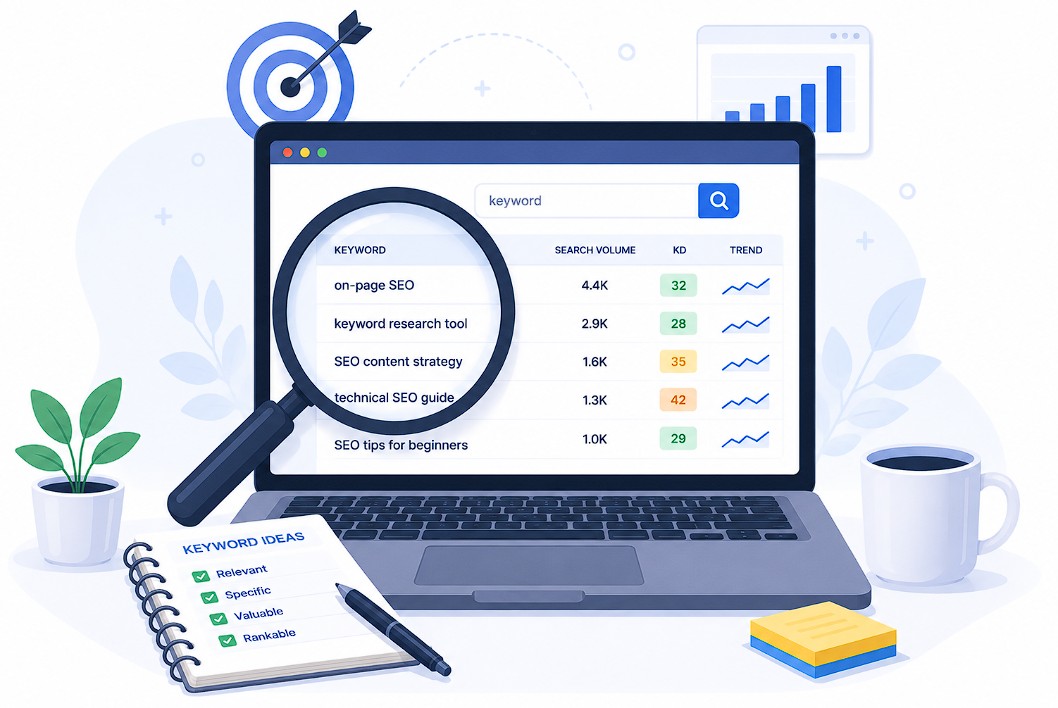
Keyword research is the foundation of an effective SEO strategy. It is the process of discovering exactly what words and phrases your target audience types into search engines and using that knowledge to create content that connects your expertise with their needs.
Without keyword research, you are guessing. You might create excellent content that ranks beautifully for terms nobody searches or miss obvious high-value opportunities that your audience searches every day. Keyword research removes that guesswork and focuses your effort where it produces real results.
Best Practice 1.1: Start With Search Intent, Not Just Search Volume
The single most important shift in keyword research thinking over the last five years is the move from volume-first to intent-first selection. Many beginners choose keywords purely based on high search volume, assuming that more searches means more opportunity. But a keyword with 10,000 monthly searches is worthless if the searchers’ intent does not align with what your website offers.
Before committing to any keyword target, search it yourself in an incognito browser and study the results page. Ask:
- What type of content dominates: articles, product pages, videos, local listings?
- Are the searchers in the early research stage or ready to take action?
- Does what you can offer match what the SERP suggests searchers want?
Only target keywords where both the volume and the intent align with your goals. A keyword with 400 monthly searches that perfectly matches your audience’s needs is far more valuable than a 4,000-search keyword that attracts the wrong audience.
Best Practice 1.2: Prioritise Long-Tail Keywords for New Websites
Long-tail keywords are longer, more specific search phrases typically three or more words that target a narrower audience but reflect very precise intent. Examples of long-tail keywords compared to their broad equivalents:
| Broad Keyword | Long-Tail Version | Why the Long-Tail Is Better for Beginners |
| SEO | SEO best practices for small businesses 2026 | Lower competition, clearer intent, easier to rank |
| digital marketing | digital marketing course for beginners in India | Highly specific audience, transactional intent, manageable competition |
| running shoes | best running shoes for flat feet women | Narrow audience, high purchase intent, achievable for new sites |
| content marketing | how to create a content marketing strategy B2B | Informational intent, detailed topic, less dominated by giant publishers |
Long-tail keywords are the fastest path to first-page rankings for a new or low-authority website. They are less competitive because they are more specific, and they often convert better because they reflect very precise user needs. As your domain authority grows, you can progressively target shorter, more competitive keywords.
Best Practice 1.3: Use Keyword Research Tools Properly
Professional keyword research requires data that only dedicated tools can provide. Here is how to use the primary tools effectively:
Google Search Console: Invaluable for finding keyword opportunities you are already close to ranking for. Filter by queries where your average position is between 8 and 20; these are pages one targeted optimisation push could move to page one.
Ahrefs Keywords Explorer: Enter a broad seed keyword and use the ‘Matching terms’, ‘Questions’, and ‘Related terms’ reports to discover hundreds of variations. Filter by Keyword Difficulty (KD) under 30 for new sites, under 50 for established sites.
Semrush Keyword Magic Tool: Similar capabilities to Ahrefs. Particularly useful for filtering by intent type: filter for ‘Informational’ queries when planning educational content, ‘Transactional’ when planning commercial pages.
Google’s free tools: ‘People Also Ask’ boxes and ‘Related Searches’ at the bottom of any SERP reveal real questions your audience has completely free, direct from Google.
Best Practice 1.4: Map Keywords to the Right Content Type
Every keyword you target should be matched to a specific page on your website, and the type of that page should match the intent of the keyword. This mapping process, sometimes called ‘keyword-to-page mapping,’ prevents the common problem of keyword cannibalisation (multiple pages targeting the same keyword and competing against each other).
| Intent Type | Best Content Format | Example Keyword | Example Page Type |
| Informational | Long-form guide, tutorial, explainer | what is technical SEO | Blog post or guide page |
| Commercial Investigation | Comparison article, roundup review | best SEO tools 2026 | Comparison/review article |
| Transactional | Product/service page with clear CTA | buy SEO course online | Product or landing page |
| Local | Location-specific service page | SEO agency Mumbai | Local landing page |
| Navigational | Homepage or key brand page | ADM digital marketing | Homepage or About page |
Best Practice 1.5: Group Keywords Into Topic Clusters
Rather than targeting individual isolated keywords, organise your keywords into topic clusters: groups of related keywords that collectively cover a subject area. A pillar page targets the broad head term, while cluster pages target more specific long-tail variations within the same topic.
This approach builds topical authority Google’s assessment of how comprehensively your website covers a subject. A website with a well-structured topic cluster covering every aspect of SEO will outrank a website with a single standalone SEO article, even if that article is excellent.
| 📝 Topic Cluster Example: SEO
Pillar page: ‘What Is SEO? The Complete Beginner’s Guide’ → targets ‘what is SEO’, ‘SEO guide’, ‘SEO for beginners’ Cluster pages: → ‘What Are SERPs?’ → targets ‘what are SERPs’, ‘SERP features’, ‘search results page’ → ‘SEO vs SEM’ → targets ‘SEO vs SEM’, ‘difference between SEO and SEM’ → ‘Search Engine Ranking Factors’ → targets ‘Google ranking factors’, ‘SEO ranking factors 2026’ → ‘SEO Best Practices’ → targets ‘SEO best practices’, ‘SEO checklist 2026’ All cluster pages link back to the pillar page. The pillar page links out to all cluster pages. Google sees comprehensive topical coverage and elevates all pages in the cluster. |
Best Practice Area 2: Content Creation
Content is the engine of SEO. Every keyword you target, every backlink you earn, every user signal you accumulate all of it depends on the quality of the content those interactions are based on. In 2026, with AI-generated content flooding the web, genuinely excellent, human-crafted, experience-driven content has never been more valuable.
Best Practice 2.1: Satisfy Search Intent Completely
The single most important content best practice is complete intent satisfaction. Your page should give searchers everything they came looking for and ideally, a little more than they expected. A searcher who reads your page and feels their question is fully answered will not return to Google to find a better answer. That satisfaction is the signal Google values most.
Intent satisfaction means:
- Answering the primary question directly and clearly; do not bury the answer under lengthy preamble
- Addressing the natural follow-up questions use People Also Ask boxes to identify what readers will want to know next
- Providing the right content format step-by-step instructions for how-to queries, comparisons for commercial queries, specific recommendations for transactional queries
- Matching the depth of the topic: simple questions deserve concise answers; complex topics deserve thorough coverage
Best Practice 2.2: Write for People First, Optimise for Search Second
This principle has always been fundamental to good SEO, and it has never been more important than in 2026. Google’s Helpful Content system explicitly penalises websites that produce content primarily designed to rank rather than content designed to genuinely help readers.
Writing for people first means:
- Using natural, conversational language that your audience actually uses
- Organising content so it is easy to read and navigate: clear headings, short paragraphs, logical flow
- Leading with value your most important information should be accessible early, not hidden at the bottom
- Being genuinely helpful rather than strategically helpful there is a meaningful difference between content written to serve readers and content written to appear as if it serves readers
- Including real examples, data, and practical application: abstract theory without practical guidance is less helpful
Best Practice 2.3: Demonstrate E-E-A-T Throughout
Experience, Expertise, Authoritativeness, and Trustworthiness (E-E-A-T) are not just quality rater guidelines; they reflect what both Google and real users look for in content they trust. Demonstrating E-E-A-T concretely throughout your content is a best practice with growing importance.
Practical ways to demonstrate E-E-A-T in content:
- Share first-hand experience and personal insights rather than purely synthesising others’ work
- Cite primary sources original research, official documentation, peer-reviewed studies rather than secondary or tertiary sources
- Include a detailed author bio on every article: credentials, experience, areas of expertise, and links to other published work
- Use data and specific examples rather than vague generalisations; specificity signals expertise
- Acknowledge nuance and complexity rather than oversimplifying. Experts understand that most topics have caveats
- Keep content updated. Outdated statistics and information undermine credibility
Best Practice 2.4: Create Comprehensive, Skimmable Content
Comprehensive content covers its topic thoroughly. Skimmable content is structured so that a reader can quickly assess whether it contains what they need and navigate directly to the relevant section. These two qualities are not in tension; the best content is both.
Make your content skimmable with:
- A clear, descriptive H1 that immediately communicates the page’s purpose
- H2 subheadings that function as signposts a reader should be able to understand the content’s structure from headings alone
- Short paragraphs (3–5 sentences maximum) that break content into digestible units
- Bullet points and numbered lists for information that is genuinely list-like (steps, features, examples)
- Bold text sparingly to highlight key terms or critical information, not decoratively
- A table of contents for long articles, especially pillar pages, allowing direct navigation to specific sections
- Summary boxes or callouts for the most important takeaways from each section
Best Practice 2.5: Publish Original Research and Unique Data
Original research surveys, studies, case studies, and data analysis are one of the most powerful content practices available. It creates content that cannot be found anywhere else, establishes genuine authority, and naturally attracts backlinks as other writers reference your findings.
You do not need a research team or a large budget to create original data. Practical approaches include:
- Survey your existing audience or customers on relevant topics in your industry
- Analyse data you already have access to customer data, website analytics, sales data and look for publishable insights
- Compile and analyse publicly available data from multiple sources into a comprehensive, well-organised resource
- Document and share detailed case studies from your own work; real results from real projects are inherently original
- Conduct expert interviews and compile insights into a collaborative research piece
Best Practice 2.6: Maintain a Content Calendar and Publish Consistently
Consistent, regular publishing is a content best practice for two reasons. First, it builds topical authority faster: a website that publishes one thorough, well-optimised article per week grows its topic coverage twice as fast as one that publishes fortnightly. Second, regular crawling rewards fresh content Googlebot returns to frequently-updated sites more often.
A realistic content calendar for a typical small business or blog:
- 1–2 new pillar pages per month comprehensive, long-form guides targeting important head terms
- 2–4 cluster articles per month supporting pages targeting more specific long-tail keywords
- Monthly refresh of the 2–3 highest-traffic existing pages: updating statistics, adding new information, improving depth
Quality always outweighs quantity. Publishing one thoroughly researched, well-written, genuinely useful article per week will outperform publishing five shallow, hastily produced articles. Never compromise quality for publishing frequency.
Best Practice 2.7: Refresh and Update Existing Content Regularly
Creating new content gets most of the attention, but refreshing existing content is often the highest-ROI SEO activity available. Pages that once ranked well but have slipped because competitors published better content, because the information has become outdated, or because user expectations have evolved can often be restored to strong positions with a thorough update.
Signs a page needs refreshing:
- Ranking has declined from its previous best position
- Traffic has dropped compared to the same period in the previous year
- Statistics or data referenced in the article are more than 12–18 months old
- Competing pages now cover the topic more comprehensively
- User experience data (high bounce rate, low dwell time) suggests the page is not meeting expectations
A content refresh should be substantive, not just changing the publication date. Add new sections, update statistics with current data, improve the structure for skimmability, add relevant internal links to recently published related content, and ensure the content still fully matches the current search intent for its target keyword.
Best Practice Area 3: On-Page SEO Optimisation
On-page SEO optimisation ensures that every page on your website clearly communicates its topic and value to both users and search engines. Think of it as the translation layer your content is the substance, and on-page optimisation ensures Google correctly understands that substance.
Best Practice 3.1: Write Compelling, Keyword-Optimised Title Tags
Your title tag is simultaneously your most important on-page SEO signal and your organic advertisement in search results. It needs to accomplish two things at once: communicate your page’s topic to Google’s algorithm and compel searchers to click your result over competing results.
Title tag best practices:
- Include your primary target keyword ideally near the beginning of the title
- Keep it under 60 characters titles beyond this length are truncated in search results with an ellipsis
- Make it specific and benefit-oriented what will the reader gain from clicking?
- Include a differentiating element the year (2026), a specific audience (for beginners), a number (15 strategies), or a modifier (complete, ultimate, proven)
- Make every page’s title unique duplicate titles are a technical SEO issue and dilute relevance signals
- Match the title to the actual content titles that overpromise relative to content increase bounce rates
Best Practice 3.2: Write Click-Worthy Meta Descriptions
Meta descriptions do not directly affect rankings but significantly affect click-through rates how many of the people who see your result actually click on it. A higher CTR from the same ranking position means more traffic without any change in your actual rank.
Meta description best practices:
- Keep it between 150–160 characters longer descriptions are truncated in results
- Include your target keyword naturally Google bolds it in results when it matches the query, making your listing more prominent
- Write it as an invitation: what will the reader find, and why should they click right now?
- Include a subtle call to action where natural ‘learn how’, ‘discover’, ‘find out exactly why’
- Make every meta description unique duplicate descriptions dilute their value and look lazy to users
- Write it for the audience, not for the algorithm this is a human-facing message, not a ranking signal
Best Practice 3.3: Use a Clean, Logical Heading Hierarchy
Your heading structure (H1 → H2 → H3) is both a user experience feature and an on-page relevance signal. It helps readers navigate your content and helps Google understand the hierarchy of topics on your page.
H1 (one per page): The main page topic. Include your primary keyword. Every page must have exactly one H1. It should closely match the title tag in substance, though it can be worded differently.
H2 (major sections): Each major topic or chapter within the page. Include secondary and semantically related keywords where natural. H2s should form a logical outline when read alone.
H3 (sub-sections): Details within H2 sections. Particularly useful for long, detailed articles where each H2 section has multiple distinct sub-components.
Never use headings for visual styling purposes (making text bigger or bold); use proper CSS styling for that. Headings have semantic meaning and should only mark actual content hierarchy. Never skip levels (e.g., going from H2 directly to H4).
Best Practice 3.4: Optimise URLs for Clarity and Keywords
Every page’s URL should clearly communicate its topic in a few words. Clean URLs are a minor ranking signal, a user trust signal, and a practical benefit for link sharing and navigation.
- Use hyphens to separate words, not underscores, spaces, or camelCase
- Keep URLs short and descriptive aim for 3–5 words that capture the page topic
- Include your primary keyword in the URL where natural
- Use all lowercase letters; uppercase letters in URLs can cause duplicate content issues on some servers
- Remove stop words (a, the, of, and) that do not add meaning
- Reflect your site structure /learn/seo/best-practices/ is better than /best-practices/ for a site with many topic categories
- Never change URLs of pages that already rank – changes require 301 redirects and can temporarily disrupt rankings
Best Practice 3.5: Build a Strong Internal Linking Structure
Internal linking is one of the most consistently under-implemented SEO best practices. Many website owners publish great content in isolation without linking from other relevant pages or ensuring new content links to related existing pages.
Internal linking best practices:
- Link to every new page from at least 2–3 existing relevant pages on your site – new content without internal links is harder for Google to discover and slower to gain authority
- Use descriptive, keyword-relevant anchor text ‘read our SEO best practices guide’ is better than ‘click here’
- Link to your most important pages more frequently – more internal links to a page signal its importance within your site
- Create a ‘hub and spoke’ structure – pillar pages link to all cluster pages, and all cluster pages link back to the pillar
- Audit for orphan pages quarterly – use Screaming Frog to identify pages with no internal links pointing to them
- Ensure no important page is more than 3 clicks from the homepage
| 💡 The Internal Linking Habit
Make internal linking a standard part of your publishing workflow. Every time you publish a new article, spend 10 minutes searching your existing content for pages that would benefit from a link to the new article. Every time you publish a new article, add at least 3 internal links within it pointing to relevant existing content. This small habit, applied consistently, builds a well-connected, well-structured site over time. |
Best Practice 3.6: Optimise Images Thoroughly
Images contribute to both the user experience and the SEO of a page, but they require specific optimisation to do so effectively:
- Compress every image before uploading – use tools like TinyPNG, Squoosh, or built-in CMS compression. Uncompressed images are among the most common page speed killers.
- Use modern formats where supported – WebP format produces files 25–35% smaller than JPEG at equivalent quality; AVIF is even more efficient. Use a fallback for older browsers.
- Set explicit width and height attributes to prevent layout shift (CLS) while the image loads.
- Write descriptive alt text for every image – describe what is in the image naturally; include a keyword where relevant and appropriate; do not keyword stuff alt text.
- Use descriptive file names ‘seo-best-practices-checklist.jpg’ rather than ‘image1.jpg’.
- Implement lazy loading for below-the-fold images – only load images when they enter the viewport, improving initial page load speed.
Best Practice 3.7: Target Featured Snippets Systematically
Featured snippets the highlighted answer boxes at Position Zero above organic results are among the highest-value on-page optimisation opportunities available. They can be earned from positions as low as #5 or #6, effectively jumping ahead of higher-ranked competitors.
How to systematically target featured snippets:
- Identify keywords in your current rankings (positions #2–#10) that show a featured snippet in the SERP.
- Note the format of the existing snippet: is it a paragraph, a numbered list, or a table?
- In your page targeting that keyword, add an H2 or H3 heading that mirrors the query as a question.
- Write a direct, concise answer immediately below the heading, 40–55 words for paragraph snippets.
- Use the matching format: numbered lists for step-by-step snippets, tables for comparison snippets.
- Monitor the SERP over the following 4–8 weeks for snippet attribution changes
Best Practice Area 4: Technical SEO
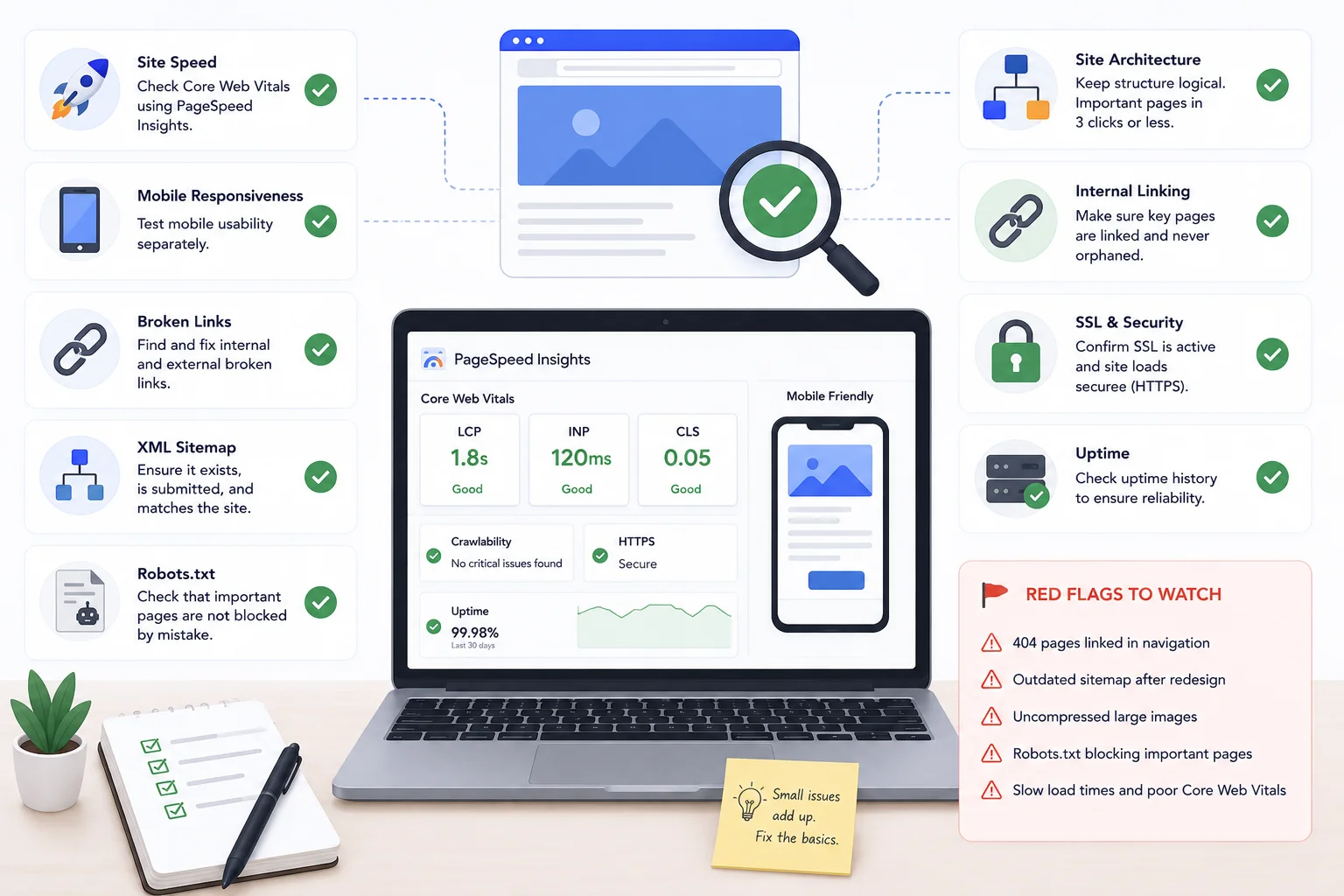
Technical SEO is the infrastructure that everything else is built upon. Even perfect content with excellent backlinks will underperform if technical issues prevent Google from properly crawling, indexing, or rendering your pages. Technical SEO does not need to be intimidating; the most important practices are straightforward to implement and check.
Best Practice 4.1: Ensure Complete and Correct Indexation
Google can only rank pages that are indexed. Confirming that all important pages are indexed and that no important pages are accidentally excluded is the most fundamental technical SEO check.
How to audit indexation:
- In Google Search Console, use the URL Inspection tool to check any specific URL’s indexation status
- Check the Coverage report in Search Console for pages showing ‘Excluded’ or ‘Error’ statuses
- Search ‘site:yourdomain.com’ in Google to get a rough count of indexed pages; compare it to the number of pages on your site
- Ensure your robots.txt file does not accidentally block important pages from crawling
- Ensure important pages do not have a ‘noindex’ meta tag applied accidentally
Best Practice 4.2: Create and Submit an XML Sitemap
An XML sitemap is a file that lists all the important pages on your website and when they were last updated. Submitting it to Google Search Console helps Googlebot discover all your pages, especially new content and pages with few internal links pointing to them.
Sitemap best practices:
- Include only pages you want indexed; do not include noindex pages, thin content pages, or redirect URLs
- Keep the sitemap updated; most CMS platforms (WordPress with Yoast SEO, Shopify, etc.) generate and update sitemaps automatically
- Submit your sitemap URL in Google Search Console under Sitemaps
- For large websites, use multiple sitemaps organised by content type (blog sitemap, product sitemap, etc.) and a sitemap index file linking them all
Best Practice 4.3: Optimise for Core Web Vitals
Core Web Vitals: Google’s three specific page experience metrics are official ranking signals. Achieving ‘Good’ scores requires targeted technical optimisation for each metric:
| Metric | Target | Most Common Fixes |
| Largest Contentful Paint (LCP) | Under 2.5 seconds | Compress and size images correctly; use a CDN; eliminate render-blocking resources; upgrade hosting |
| Interaction to Next Paint (INP) | Under 200ms | Reduce JavaScript execution time; defer non-critical JS; break up long tasks; minimise third-party scripts |
| Cumulative Layout Shift (CLS) | Under 0.1 | Set width/height on all images and videos; reserve ad space; avoid inserting content above existing elements after load |
Measure your current scores using Google PageSpeed Insights, the Core Web Vitals report in Search Console, and Lighthouse in Chrome DevTools. Prioritise fixing pages with ‘Poor’ scores, then work toward ‘Good’ scores across all important pages.
Best Practice 4.4: Implement HTTPS Sitewide
HTTPS (the secure, encrypted version of HTTP) is a confirmed ranking signal and a user trust signal. Every modern website should be served over HTTPS this is no longer optional. Chrome and other browsers display ‘Not Secure’ warnings for HTTP pages, which significantly reduces user confidence and click-through rates from search results.
Implementation steps:
- Obtain an SSL/TLS certificate – free options are available through Let’s Encrypt, and most hosting providers offer free SSL installation.
- Install the certificate and configure your server to serve all pages over HTTPS.
- Set up 301 redirects from all HTTP URLs to their HTTPS equivalents.
- Update all internal links from HTTP to HTTPS.
- Update your sitemap to use HTTPS URLs.
- Verify HTTPS in Google Search Console.
Best Practice 4.5: Fix Broken Links and Redirect Chains
Broken links (links pointing to pages that return a 404 error) are a poor user experience and waste crawl budget. Redirect chains (multiple consecutive redirects: A→B→C→D) dilute link authority and slow page loading. Both should be identified and fixed regularly.
Use Screaming Frog SEO Spider to crawl your entire website and identify:
- Pages returning 404 errors (broken pages) fix by updating the link or setting up a 301 redirect to the most relevant live page
- Redirect chains consolidate into single, direct 301 redirects (A→D, not A→B→C→D)
- Redirect loops – pages that redirect to each other in a circular pattern; these must be broken immediately as they make pages inaccessible
Best Practice 4.6: Use Canonical Tags Correctly
Canonical tags (rel=”canonical”) tell Google which version of a URL is the definitive original when the same or very similar content is accessible at multiple URLs. This prevents duplicate content issues from diluting ranking signals.
Common scenarios requiring canonical tags:
- E-commerce product pages accessible under multiple category paths /shoes/running/product-x/ AND /sale/product-x/ use canonical to point to the primary URL
- HTTP and HTTPS versions of the same page ensure canonical points to the HTTPS version
- www and non-www versions consistently canonicalise to one preferred version
- URL parameters tracking parameters (?utm_source=email) often create duplicate URLs; canonical the parameter URLs to the clean URL
Best Practice 4.7: Implement Structured Data
Structured data (Schema Markup) tells Google explicitly what your content is about enabling Rich Results that make your SERP listing more visually prominent and informative. While structured data is not a direct ranking factor, the Rich Results it enables can significantly improve click-through rates.
Priority structured data implementations for most websites:
- Organization or LocalBusiness schema on the homepage
- Article or BlogPosting schema on all blog posts and articles
- FAQPage schema on pages with FAQ sections (where eligible)
- Product schema on e-commerce product pages
- Review/AggregateRating schema where reviews exist
- BreadcrumbList schema sitewide for cleaner SERP URL display
Use Google’s Rich Results Test tool to verify your structured data is correctly implemented and eligible for rich result display. Monitor the Enhancement reports in Google Search Console to track rich result coverage and identify errors.
Best Practice 4.8: Optimise Your Website Architecture
Site architecture how your pages are organised and connected affects both user experience and SEO. A logical, flat architecture ensures all important pages can be reached quickly, receives consistent internal link authority, and is efficiently crawled.
Architecture best practices:
- Keep your structure shallow – ideally, no important page is more than 3 clicks from the homepage
- Use a consistent, logical URL hierarchy that reflects your content structure
- Ensure every page in your navigation is accessible from any other page within a few clicks
- Avoid excessive subfolders /blog/category/subcategory/article/ creates deep pages that receive limited crawl attention
- Create category/hub pages for major topic areas – these aggregate internal authority and help Google understand your content structure
Best Practice Area 5: Link Building
Link building – earning backlinks from other reputable websites remains one of the most impactful SEO activities, particularly for competitive keywords. It is also one of the most misunderstood and most commonly done incorrectly. The guiding principle of ethical, effective link building is simple: earn links by creating genuine value, not by manipulating or paying for placement.
Best Practice 5.1: Create Link-Worthy Content First
The foundation of sustainable link building is having content worth linking to. Before investing in outreach, ensure you have a set of pages that provide enough unique value that other websites would genuinely want to reference them.
The most naturally link-attracting content types:
- Original research and data: Studies, surveys, and statistics that others need to cite when writing about the topic
- Comprehensive definitive guides: The most thorough, well-organised resource on a topic becomes the default reference
- Original tools and calculators: Free tools your audience finds genuinely useful attract natural links over time
- Unique visual content: Infographics, diagrams, and data visualisations are shared and linked to frequently
- Expert roundups: Articles featuring insights from multiple respected experts attract links from all participants
- Contrarian or surprising insights: Well-evidenced takes that challenge conventional wisdom generate discussion and citation
Best Practice 5.2: Practise Quality-First Link Acquisition
The quality of your backlinks matters far more than the quantity. One link from a relevant, respected national publication is worth more than 500 links from obscure, low-quality directories. When evaluating a link opportunity, ask:
- Is the linking website authoritative and reputable in its own right?
- Is the linking website relevant to my industry or the topic of the linked page?
- Is the link placed naturally within relevant content – not in a footer, widget, or boilerplate section?
- Is this a unique referring domain I do not already have a link from? New referring domains have higher marginal value.
- Would this link still make sense if SEO did not exist – would an editor naturally want to reference this page?
Best Practice 5.3: Guest Posting on Reputable Publications
Guest posting – writing high-quality articles for other reputable websites in your industry in exchange for an author credit and contextual link is one of the most reliable link-building strategies when done correctly.
Guest posting best practices:
- Target publications with genuine readership, editorial standards, and strong domain authority in your niche
- Pitch genuinely original, high-quality article ideas that serve the publication’s audience, not thinly veiled advertisements for your own work
- Include your link naturally within the article body, contextually relevant to the surrounding content
- Build relationships with editors over time; one good guest post in a publication often opens doors to future opportunities
- Avoid guest posting purely for links on sites with no real readership; these provide minimal SEO value and potential risk
Best Practice 5.4: Digital PR and Earned Media
Digital PR proactively earning coverage in online publications, industry blogs, and news sites is one of the most scalable and highest-quality link-building approaches. When executed well, a single PR campaign can generate dozens of high-authority links from a diverse range of referring domains.
Effective digital PR tactics:
- Data stories: Conduct a survey or analysis and pitch the findings to journalists covering your industry
- Expert commentary: Register on platforms like Help a Reporter Out (HARO) and Terkel to respond to journalist requests for expert quotes
- Newsjacking: When a story in your industry breaks, quickly publish expert commentary or data that journalists can reference
- Awards and recognition: Applying for industry awards generates coverage whether or not you win
- Sponsorships and partnerships: Sponsoring relevant events, organisations, or publications often includes a link in their sponsor listings
Best Practice 5.5: Broken Link Building
Broken link building is a tactically systematic approach: find relevant pages on other websites that contain broken links (links pointing to pages that no longer exist), then suggest your content as a relevant replacement. Website owners are motivated to fix broken links because they represent a poor user experience, and suggesting a replacement makes fixing them easy.
- Use Ahrefs or Semrush to find pages on relevant websites with broken outbound links.
- Check whether any of those broken links pointed to content similar to content you have (or could create).
- If yes, reach out to the website owner, politely flag the broken link and suggest your page as a replacement.
- Keep outreach concise and genuinely helpful; you are doing them a favour, not asking for one.
Best Practice 5.6: Monitor and Protect Your Backlink Profile
Building links is only half of backlink management. Monitoring your profile regularly ensures you catch and address problems before they affect rankings:
- Set up Ahrefs or Semrush alerts to notify you of new and lost backlinks; lost links from important referring domains should prompt outreach to investigate why
- Regularly check for new toxic or spammy links; if you find a pattern of clearly harmful links, consider whether disavowal is warranted
- Monitor competitor backlink profiles – new links to competitors may reveal link-building opportunities you are missing
| ⚠️ What to Avoid in Link Building
Buying links from any source: this violates Google’s Webmaster Guidelines and risks a manual penalty that can be very difficult to recover from. Joining link exchange schemes at scale: reciprocal linking as a primary strategy is manipulative and risky. Using Private Blog Networks (PBNs) Google actively identifies and ignores (or penalises) PBN links. Posting links in irrelevant blog comments or forum signatures: these have no SEO value and often violate site policies. Any tactic that feels like it is ‘gaming the system ‘- if you would not want Google to know you are doing it, do not do it. |
👉 Learn More: Complete SEO Beginner’s Guide
Best Practice Area 6: User Experience (UX) for SEO
User experience and SEO have always been deeply interconnected. Google’s goal has always been to direct users to the best possible experience. In 2026, the connection is more explicit than ever: Core Web Vitals are official ranking signals, mobile-first indexing is universal, and engagement signals directly influence ranking stability. Investing in user experience is investing in SEO.
Best Practice 6.1: Design for Mobile First
With more than 60% of searches happening on mobile devices globally and higher in many markets, including India and Google’s mobile-first indexing policy, your mobile experience is your primary SEO experience. Design and develop your website for mobile first, then enhance for larger screens.
Mobile UX best practices for SEO:
- Use a responsive design that fluidly adapts to any screen size never a separate ‘m.’ subdomain site
- Minimum 16px font size for body text on mobile smaller text requires zooming and significantly degrades experience
- Touch targets (buttons, links) should be at least 48x48px and spaced at least 8px apart prevents accidental taps
- No horizontal scrolling all content should be accessible without scrolling sideways on any device
- Avoid intrusive full-screen pop-ups on mobile; Google penalises these as they prevent access to content
- Test on real mobile devices, not just browser simulation. Real device testing reveals issues that simulations miss
Best Practice 6.2: Optimise Page Speed Aggressively
Page speed directly affects both Core Web Vitals scores and user experience. Every second of load time increases the probability that a user will abandon your page before it fully loads with research showing that pages loading in 1 second convert 5x better than pages loading in 10 seconds.
Speed optimisation priorities (highest impact first):
- Image optimisation: Compress all images, use WebP format, implement lazy loading; images are the #1 cause of slow pages
- Enable browser caching: Allows returning visitors to load your pages faster by storing static assets locally
- Use a CDN (Content Delivery Network): Serves your content from servers physically close to each user, reducing latency
- Minimise and defer JavaScript: Remove unused JS, defer non-critical scripts, break up long tasks
- Minimise CSS: Remove unused CSS rules; avoid render-blocking stylesheet loading
- Choose fast hosting: Your hosting provider’s server response time (TTFB) is the foundation of all page speed metrics
- Enable compression: Gzip or Brotli compression reduces transfer sizes of HTML, CSS, and JS files by up to 70%
Best Practice 6.3: Make Content Genuinely Easy to Read
Readability directly affects engagement metrics: time on page, scroll depth, and return visits, which in turn influence ranking stability. Content that is cognitively demanding or visually tiring to read will lose readers before they find what they need.
Readability best practices:
- Keep paragraph length to 3–5 sentences; shorter paragraphs feel less intimidating and are easier to process
- Use simple, clear language. Grade 8–10 reading level is ideal for most general audiences (use the Hemingway Editor to check)
- Use active voice rather than passive active constructions are clearer and more engaging
- Avoid excessive jargon; explain technical terms when first introduced
- Use transition words and phrases to create logical flow between ideas
- Choose a readable font, appropriate size (16px minimum body text), and sufficient line height (1.5–1.7x)
- Ensure sufficient contrast between text and background; the WCAG standard of 4.5:1 contrast ratio is the minimum
Best Practice 6.4: Reduce Friction in Navigation and CTAs
Beyond content readability, the overall usability of your website how easy it is to find information and take desired actions is a UX factor with SEO implications. High bounce rates and low pages-per-session often indicate navigation friction rather than content problems.
- Maintain a clear, consistent navigation menu on every page; users should always know where they are and how to get to related content
- Include breadcrumb navigation on category and content pages; it helps users understand their location within your site structure
- Place your most important CTAs above the fold, visible without scrolling on the relevant device
- Avoid auto-playing videos and audio; these are among the most common reasons users immediately leave a page
- Ensure your search functionality works well; for content-heavy sites, on-site search is a critical UX feature
Best Practice Area 7: Local SEO Best Practices
For businesses serving specific geographic areas restaurants, clinics, law firms, retail stores, plumbers, gyms, and countless others local SEO is often the highest-value SEO investment available. Appearing in Google’s Local Pack (the map with three business listings) for relevant local searches can transform a business’s visibility and inbound enquiry volume.
Best Practice 7.1: Claim and Fully Optimise Your Google Business Profile
Your Google Business Profile (GBP), formerly Google My Business, is the single most important asset in local SEO. It is the primary source of the information Google uses for your Local Pack listing and a standalone visibility tool in its own right.
Google Business Profile optimisation checklist:
- Verify your listing; unverified listings have significantly reduced visibility
- Choose the most accurate primary category this is the most important relevance signal in GBP
- Add all relevant secondary categories
- Write a keyword-rich, genuinely informative business description (750 character limit)
- Add complete, accurate contact information: name, address, phone number, website
- Set accurate opening hours including special holiday hours
- Upload a minimum of 10 high-quality photos: exterior, interior, team, products/services
- List every service you offer with descriptions
- Publish regular Google Posts updates, offers, events, new products
- Enable and respond to every message through GBP messaging
Best Practice 7.2: Build and Manage Online Reviews
Reviews are the most impactful single factor in Local Pack rankings, above proximity and above website authority. Businesses with more reviews and higher average ratings consistently outrank competitors in the Local Pack.
Review management best practices:
- Ask every satisfied customer for a Google review; make it easy by sending a direct link to your review form
- Build review requests into your operational workflow post-purchase emails, follow-up calls, or end-of-service messaging
- Respond to every review thank positive reviewers genuinely and specifically; respond to negative reviews professionally, empathetically, and constructively
- Never offer incentives for reviews; this violates Google’s policies and can result in review removal or profile suspension
- Never post fake reviews; this is a serious policy violation with severe consequences
- Diversify review platforms while Google is primary, reviews on Facebook, Trustpilot, and industry-specific platforms support overall prominence
Best Practice 7.3: Maintain Consistent NAP Citations
NAP consistency, ensuring your business Name, Address, and Phone number are identical across all online mentions, is a fundamental local SEO signal. Inconsistencies confuse Google about your business identity and reduce trust in your entity signals.
Build and maintain citations on:
- Major general directories: Google Business Profile, Bing Places, Apple Maps, Facebook, Justdial (India), Sulekha (India)
- Industry-specific directories: Medical directories for healthcare, legal directories for law firms, restaurant aggregators for food businesses
- Local directories: City-specific directories, local chamber of commerce listings, local newspaper business directories
Use a consistent format for your NAP across all platforms if your address is ’42 MG Road, Bengaluru 560001′ on your website, use that exact format everywhere. Even small variations (Road vs Rd, suite number placement) create inconsistency signals.
Best Practice 7.4: Create Location-Specific Content
For businesses serving multiple locations, or for businesses wanting to rank for location-specific keywords organically (below the Local Pack), location-specific content is essential.
- Create a unique, substantive page for each city or area you serve not thin template pages with only the city name changed
- Include local landmarks, area-specific information, and locally relevant content that demonstrates genuine local expertise
- Target location-based keywords naturally: ‘dental implants Chennai’, ‘SEO agency in Hyderabad’, ‘plumber South Mumbai’
- Embed a Google Map on your contact page and location pages
- Implement LocalBusiness Schema Markup to help Google understand your location, hours, and services
| 👉 Learn More: What Is SEO? The Complete Beginner’s Guide |
Best Practice Area 8: Measurement and Analytics
Without measurement, SEO is guesswork. Without the right metrics, even diligent measurement can mislead. The final pillar of SEO best practices is knowing exactly what to measure, how to measure it, and how to use that data to continuously improve your strategy.
Best Practice 8.1: Set Up Your Core Analytics Stack
Every website should have these three tools set up before any significant SEO work begins:
Google Search Console (free): Your most direct source of SEO performance data: keyword impressions, clicks, average positions, CTR, indexation status, Core Web Vitals scores, and manual action notifications. Set this up on day one.
Google Analytics 4 (free): Tracks user behaviour on your website, where traffic comes from, what pages users visit, how long they stay, what they do, and whether they convert. Essential for understanding the business impact of your SEO work.
A rank tracking tool (paid): Google Search Console shows average positions but not daily ranking snapshots for specific target keywords. Ahrefs Rank Tracker or Semrush Position Tracking allow you to monitor exactly where your target keywords rank each day or week.
Best Practice 8.2: Track the Metrics That Matter
With data available on hundreds of metrics, the risk is tracking everything and understanding nothing. Focus on a core set of SEO KPIs that directly reflect your strategic goals:
| Metric | What It Tells You | How to Track It | Review Frequency |
| Organic sessions | How much traffic SEO is generating | Google Analytics 4 | Weekly |
| Keyword rankings | Position of target keywords | Ahrefs / Semrush / Search Console | Weekly |
| Organic CTR | % of searchers clicking your results | Google Search Console | Monthly |
| Impressions | How often your pages appear in search | Google Search Console | Monthly |
| Organic conversion rate | % of SEO visitors completing goals | Google Analytics 4 | Monthly |
| Referring domains | Growth of unique backlink sources | Ahrefs / Semrush | Monthly |
| Core Web Vitals scores | Page experience performance | Search Console / PageSpeed Insights | Monthly |
| Indexed pages | Whether all important pages are indexed | Google Search Console | Quarterly |
Best Practice 8.3: Run Monthly SEO Reviews
Data without review and action produces no improvement. Build a monthly SEO review process into your workflow. A structured monthly review should cover:
- Traffic review: How did organic traffic perform this month vs. last month and vs. the same month last year? Any significant changes?
- Rankings review: Which keywords improved in position? Which declined? Any major shifts after a Google algorithm update?
- Content performance: Which pages are gaining traffic? Which are declining and need refreshing?
- Technical health: Any new crawl errors, indexation issues, or Core Web Vitals regressions in Search Console?
- Link profile: How many new referring domains have been added? Have any important backlinks been lost?
- Next month priorities: Based on the data, what are the highest-priority actions for the next 30 days?
Best Practice 8.4: Connect SEO Metrics to Business Outcomes
The final and most important measurement best practice is connecting your SEO performance to actual business results. Organic traffic and keyword rankings are useful intermediate metrics, but the ultimate measure of SEO success is business impact:
- Track organic goal completions in GA4 – form submissions, phone calls, purchases, sign-ups, or whatever conversion actions matter to your business
- Calculate organic revenue or organic-attributed pipeline where possible – this is the ultimate argument for SEO investment
- Monitor branded search volume growth over time; increasing branded searches indicate SEO is building genuine brand awareness
- Report on cost per acquisition (CPA) from organic search compared to paid channels – this demonstrates the long-term ROI advantage of SEO
SEO Best Practices Specific to 2026
The eight foundational pillars above are timeless. But SEO in 2026 also requires addressing the specific realities of where search is today, particularly the rapid advancement of AI in search and the evolving nature of SERPs.
Best Practice: Optimise for AI Overviews
Google AI Overviews now appear at the top of results for a significant portion of informational queries. Being cited as a source within an AI Overview is the new ‘Position Zero’ even more prominent than a featured snippet because AI Overviews appear before everything else on the page.
How to improve your chances of AI Overview citation:
- Build deep topical authority – websites that comprehensively cover entire topic areas are more likely to be trusted as sources
- Use clear, structured content that AI systems can easily parse and extract – well-organised headings, concise answers, and factual precision
- Cite primary sources – AI systems favour content that references credible sources rather than making unsubstantiated claims
- Implement Schema Markup – structured data helps AI systems understand your content’s context and reliability
- Maintain E-E-A-T signals rigorously – AI systems increasingly prioritise content from verifiably authoritative sources
Best Practice: Prioritise Topical Authority Over Individual Keywords
The era of ranking individual pages for isolated keywords with minimal site context is over. Google’s AI-powered systems increasingly evaluate the entire website’s topical authority when determining rankings for any individual page.
This means the most effective SEO strategy in 2026 is building comprehensive coverage of your core topic area, not optimising standalone pages in isolation. Every new content piece should serve the broader topical authority of your site, not just target an individual keyword.
Best Practice: Publish Content That Passes the ‘Could AI Have Written This?’ Test
As AI-generated content becomes ubiquitous, Google’s Helpful Content system is specifically designed to detect and demote content that lacks genuine human expertise, first-hand experience, and original insight. The new benchmark for content quality is: could this have been generated by AI, or does it clearly reflect genuine human experience and original thinking?
Content that passes this test includes:
- First-hand accounts: ‘We tested this tool for 30 days and here is what we found’ not ‘Tool X is widely used for…’
- Specific, verifiable data from your own experience or research, not repackaged industry statistics
- Opinions and perspectives that reflect genuine expertise and considered judgment
- Case studies with real numbers, real clients, and real outcomes
- Acknowledged limitations, trade-offs, and nuance experts know that nothing is perfectly straightforward
Best Practice: Build for Zero-Click Searches as Well as Clicks
Zero-click searches where users find their answer directly on the SERP through AI Overviews, featured snippets, or knowledge panels without clicking any result are growing. This does not make SEO less valuable, but it does change what ‘success’ looks like.
Strategies for zero-click environments:
- Be the cited source even if the user does not click; being named as the authority in an AI Overview builds brand recognition and trust
- Target transactional and commercial queries more aggressively these are less susceptible to zero-click behaviour than purely informational queries
- Build brand awareness through SERP visibility – appearing repeatedly in results for relevant queries creates a familiarity effect that drives branded searches over time
- Create content that generates follow-up searches – comprehensive content naturally prompts users to search for related topics, keeping your brand in the consideration set
Common SEO Best Practice Violations to Avoid
Understanding what to do is one half of SEO best practices. Understanding the most common mistakes and the practices that consistently hurt rankings despite feeling productive is the other half.
Mistake 1: Prioritising Quantity Over Quality in Content
The temptation to publish as much content as possible, reasoning that more pages means more ranking opportunities, leads many beginners to produce large volumes of thin, shallow content. This strategy backfires badly. Google’s Helpful Content system evaluates quality signals across your entire website. A significant proportion of thin, unhelpful content can depress rankings for all your pages, including the good ones. Publish less, but make every piece genuinely excellent.
Mistake 2: Keyword Cannibalisation
Creating multiple pages that target the same keyword causes them to compete against each other in Google’s algorithm, splitting their authority and weakening both. Common cannibalisation patterns: a category page and several blog posts all targeting the same keyword; multiple service pages targeting the same location query; an old post and a new post about the same topic coexisting without consolidation. Audit for cannibalisation regularly using Semrush’s Keyword Cannibalisation report or by searching ‘site:yourdomain.com + target keyword’ and reviewing what comes up.
Mistake 3: Neglecting Technical SEO After Initial Setup
Many website owners do a technical SEO setup once, fix the obvious issues, submit a sitemap, get HTTPS and never revisit it. But websites are living systems. New pages are published, old pages redirect, content management systems update, and plugins change; all of these can introduce new technical issues. Schedule a full technical SEO audit at least every six months using Screaming Frog or a similar crawler.
Mistake 4: Building Links Without Building Content
Link building without high-quality content to link to is ineffective. Links to thin, unhelpful pages pass authority to pages that do not merit ranking well. The correct sequence is: create excellent content → earn links to that excellent content → rankings improve. Reversing this sequence building links to poor content and hoping rankings follow does not work in Google’s current algorithm environment.
Mistake 5: Ignoring Mobile Experience
In a mobile-first indexing world, a website that is not properly optimised for mobile is a website that is not properly optimised for Google. Despite years of mobile-first indexing announcements, mobile experience problems remain common. Test every new page on a real smartphone before publishing. Review the Mobile Usability report in Search Console monthly.
Mistake 6: Setting and Forgetting
SEO is not a project with a completion date; it is a continuous programme. Websites that invest heavily in SEO for 6 months and then stop often find their rankings gradually erode as competitors who continue investing progressively outpace them. The most successful SEO programmes have consistent, ongoing investment in content, links, and technical health, not peaks followed by abandonment.
Conclusion
Every SEO best practice in this guide shares a common characteristic: it serves users genuinely, and it builds sustainable, compounding value over time. None of them produces overnight results. All of them, applied consistently, produce results that last.
The businesses and websites that dominate organic search in their industries did not get there through clever tricks or algorithm exploits. They got there by doing the fundamentals exceptionally well, consistently, over years. Excellent content. Technical health. Earned authority. User experience that genuinely delights.
That is the real secret of SEO best practices; there is no secret. There is just quality, consistency, and patience.
Start with the foundations. Build your content systematically. Earn links through genuine value. Keep your technical house in order. Measure relentlessly and improve continuously. The compounding returns of this approach, applied over 12–24 months, will produce an organic presence that your competitors will struggle to replicate because it is built on real expertise, real value, and real trust.
Frequently Asked Questions
What are the most important SEO best practices for a new website?
For a brand-new website, the priority order is: (1) technical foundations HTTPS, indexability, sitemap, mobile-friendliness; (2) keyword research understand what your audience searches before creating content; (3) content creation publish comprehensive, intent-matched content targeting achievable long-tail keywords; (4) on-page optimisation title tags, headings, meta descriptions, internal links; (5) basic link building even a few high-quality links to start building domain authority. Do not attempt all of these simultaneously from day one; the sequence matters.
How often should I update my SEO strategy?
Your core strategy topic clusters, target keyword list, and content calendar should be reviewed quarterly. Your tactics should be reviewed monthly based on performance data. Major Google algorithm updates (which happen several times a year) sometimes require strategic adjustments. Your ongoing SEO activities content creation, link building, technical maintenance should happen consistently every month, not in sporadic bursts.
Is it better to have many short articles or fewer longer ones?
Neither length alone is the right target; intent satisfaction and comprehensiveness are. A simple question deserves a concise, direct answer. A complex topic deserves thorough coverage. In practice, pillar pages and guides tend to be long (2,000–7,000+ words) because complex topics require substantial explanation. Targeted blog posts addressing specific questions may be excellent at 800–1,500 words. Let the topic and the intent determine the length, not an arbitrary target.
How do I know if my SEO is following best practices?
Regularly audit against this framework: conduct monthly technical audits using Search Console; compare your content against top-ranking competitors for each target keyword; review your backlink profile monthly in Ahrefs or Semrush; check Core Web Vitals scores; monitor keyword rankings weekly. If rankings are growing, traffic is increasing, and your technical health is clean your practices are working. If not, the data will indicate which area needs attention.
Do I need to follow every best practice to rank well?
No, and trying to implement every practice simultaneously as a beginner is a recipe for paralysis. The 80/20 principle applies: excellent content matched to search intent, clean on-page optimisation, basic technical health, and a growing backlink profile will produce the vast majority of SEO results. The more specialised practices (featured snippet targeting, schema markup, AI Overview optimisation) become important as your baseline is established and you compete for more competitive positions.
How long does it take to see results from SEO best practices?
For low-competition keywords on an established website, well-optimised new content can rank within 4–8 weeks. For competitive keywords on a new website, expect 6–12 months of consistent work before meaningful organic traffic materialises. The timeline depends on keyword competitiveness, your current domain authority, content quality, and how actively you build backlinks. Track leading indicators: impressions and positions growing in Search Console to see progress before traffic fully materialises.
Are SEO best practices different for e-commerce websites?
The fundamental practices are the same, but e-commerce has specific emphases: product pages require unique, detailed descriptions (never duplicate manufacturer copy); category pages are important ranking assets that need their own content strategy; product schema markup for prices and availability is essential; faceted navigation (filters by size, colour, price) requires careful technical handling to avoid index bloat; and rich results for products (star ratings, price, availability) are high-priority implementations that directly impact click-through rates.
Should I do SEO myself or hire an agency?
This depends on your budget, time, and technical comfort level. Many foundational practices keyword research, content creation, on-page optimisation, Google Business Profile management are learnable and executable by motivated non-specialists. Technical SEO and link building at scale benefit from professional expertise. A pragmatic approach: learn and implement the fundamentals yourself using resources like this guide, invest in professional help for technical audits and link building campaigns, and hire a full SEO agency when your business has grown to the point where your organic channel justifies that investment.